Calorie Trackers for Singapore Hawker Food: A Sourced Comparison
We build NutriKaki, so treat this as what it is: a comparison written by an interested party. We have tried to make that bias harmless by doing two things. Every claim about another app is sourced from that company's own documentation and linked at the bottom. And there is a section near the end listing the cases where NutriKaki is the wrong choice and you should use something else — because there are several, and pretending otherwise would waste your time.
The Actual Problem With Tracking Hawker Food
Calorie trackers can handle local food badly in one of two ways.
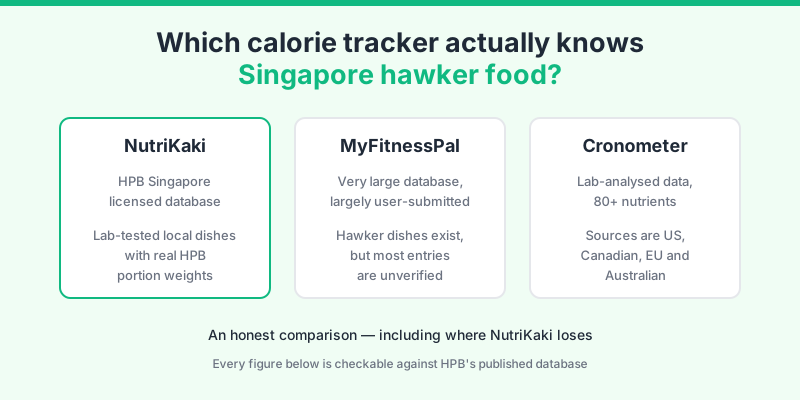
The first way is a database where most entries are unreviewed. Large trackers get their size from user submissions. MyFitnessPal's help pages describe a database of "19 million foods and counting" and explain that a check mark "shows that a food or medication entry has been reviewed or added by MyFitnessPal and is considered accurate and complete." To their credit, they are careful about what that does and does not mean, and we will quote them rather than paraphrase: "items without a check mark are not always wrong, and even verified entries can sometimes have mistakes."
That is a reasonable trade, and it is why the database is enormous and why your specific brand of oat milk is in there. But it does mean that when you search a hawker dish and get a list of entries, most of them have not been reviewed by anyone, and you are the one deciding which to trust. Two people logging the same plate of char kway teow can end up with very different numbers depending on which row they tap.
The second way is the more subtle one: excellent data about the wrong food. Cronometer is built specifically for accuracy, and its lab-analysed sources are genuinely first-rate — the USDA database, the NCCDB curated by the University of Minnesota, the Canadian Nutrient File, Australia's NUTTAB, the UK's CoFID, and others. Notice what is not on that list. None of them are Singaporean. A national food composition database contains the composite dishes of that nation, so char kway teow, chwee kueh, lor mee and mee rebus are generally not sitting in there as single lab-tested entries. You can construct them ingredient by ingredient, and that is a legitimate approach, but you will be doing it manually for every hawker meal you eat.
Portion Size Is the Bigger Error, Not Calories per 100g
This is the part most comparisons skip, and it matters more than the nutrient values.
Singapore's Health Promotion Board publishes not just per-100g nutrient data but a separate Portion database recording what a standard serving of each dish actually weighs. Those weights are frequently much larger than people assume. Here are HPB's own figures — the per-100g value, the recorded standard portion, and what the whole plate therefore comes to:
| Dish | Per 100g | HPB standard portion | Whole serving |
|---|---|---|---|
| Mala xiang guo (dry) | 162 kcal | 719g plate | 1,165 kcal |
| Char kway teow | 206 kcal | 480g plate | 989 kcal |
| Mee goreng | 184 kcal | 465g plate | 856 kcal |
| Nasi lemak (chicken wing set) | 218 kcal | 410g plate | 831 kcal |
| Hokkien mee | 152 kcal | 549g plate | 830 kcal |
| Wanton noodles (soup) | 95 kcal | 678g bowl | 644 kcal |
| Thunder tea rice (lei cha) | 142 kcal | 431g bowl | 612 kcal |
| Fried carrot cake (black) | 183 kcal | 331g plate | 606 kcal |
| Bak chor mee (dry) | 131 kcal | 430g bowl | 563 kcal |
| Steamed chicken rice | 151 kcal | 346g plate | 488 kcal |
| Laksa | 71 kcal | 604g bowl | 429 kcal |
Two things fall out of this table that are worth more than any feature list.
Per-100g figures are almost useless on their own for hawker food. Laksa looks like the lightest dish on the list at 71 kcal per 100g — lower than steamed chicken rice at 151. And it is, per serving. But it only stays lower because a bowl of laksa, at 604g, is one of the heavier servings here. Rank dishes by the per-100g column and you get a meaningfully different order than ranking them by the whole-serving column. Both columns are correct. They answer different questions, and most apps only show you one.
An app that guesses portion size can be wrong by more than a whole meal. If a tracker assumes a 300g plate of char kway teow rather than HPB's recorded 480g, it will report roughly 620 kcal instead of 989. That gap — around 370 kcal, silently, on one dish — is larger than most people's daily deficit. Nothing about the nutrient data has to be wrong for this to happen. Only the assumed weight.
The Comparison
We have deliberately left prices out of this table. Both have changed pricing or restructured tiers within the last two years, and any number we print here will be stale before long — the links in the Sources section go to each company's live pricing page, which is the only figure worth trusting. NutriKaki's own pricing is on our homepage and there is a permanent free tier.
| NutriKaki | MyFitnessPal | Cronometer | |
|---|---|---|---|
| Where the data comes from | HPB Singapore's food composition database, under licence | Largely user-submitted, plus a reviewed subset marked with a check | Lab-analysed national databases: USDA, NCCDB, CNF, NUTTAB, CoFID and others |
| Hawker dishes as single lab-tested entries | Yes | Present, but mostly unverified entries | Generally not — build from ingredients |
| Real HPB portion weights | Yes, and shown alongside the per-100g figure | Varies by entry | You set the weight |
| Database size for packaged / Western food | Small — this is a real limitation | Very large, the strongest of the three | Large, with strong branded coverage |
| Micronutrient depth | Calories, macros, sodium, sugar, purine | Moderate | Deepest of the three, 80+ nutrients |
| Photo logging | Yes | Yes — Meal Scan, Premium only | Yes — Photo Logging, Gold only |
| Best suited to | People eating mostly local food who want whole-plate numbers from HPB data | People eating mostly packaged and branded food | People who want serious micronutrient detail |
Where NutriKaki Is the Wrong Choice
This is the section we would want to read first if someone else had written this page.
- You eat mostly packaged or Western food. Our public nutrition database is a curated set of a few hundred pages, and even the fuller in-app database is oriented around Southeast Asian food. MyFitnessPal's database is orders of magnitude larger. If your day is protein bars, supermarket brands and chain restaurants, it will find your item and we often will not.
- You want deep micronutrient tracking. We track calories, macros, sodium, sugar and purine. Cronometer tracks over 80 nutrients against lab-analysed sources. If you are managing something that depends on specific vitamins or minerals, that is not a close call — use Cronometer.
- You live outside Southeast Asia. The entire value proposition here is a Southeast Asian food database. Outside that context, most of the advantage disappears.
- You want the whole HPB database dumped in front of you. We licence this data; we do not own it. That licence is why we publish a curated subset of nutrition pages rather than all ~2,690 of them. If you want the raw national dataset, HPB is the place to go, not us.
- You want a mature product with a decade of community behind it. NutriKaki launched in 2026 and is built by a small team in Singapore. MyFitnessPal has been around since 2005. That difference shows up in integrations, edge cases and sheer accumulated polish, and no amount of better local data changes it.
How to Check Any of This Yourself
You should not take our word for the numbers, and you do not have to.
The Health Promotion Board publishes its food composition database publicly. Every whole-serving figure in the table above is that database's per-100g value multiplied by its recorded portion weight and its edible-portion percentage — that last term is easy to forget and will throw your arithmetic out if you skip it. Pick any dish, run the calculation, and see whether our number matches.
Every nutrition page on this site shows the per-100g figure and, where the dish has a recorded standard portion, the whole-serving total next to it, specifically so the two cannot be confused. Each page also has a plain-Markdown version at the same URL with .md appended, if you would rather read the data without the page around it. We wrote up how HPB's lab-tested figures differ from crowdsourced ones in where our numbers come from.
Frequently Asked Questions
Which calorie tracking app suits Singapore hawker food?
It depends on what you eat most. For Singapore hawker dishes specifically, an app built on the Health Promotion Board's licensed food composition database will give you lab-tested figures and HPB's own measured portion weights. For packaged Western groceries and branded restaurant items, MyFitnessPal's much larger database is more likely to contain what you are looking for. For detailed micronutrient tracking across 80-plus nutrients, Cronometer is the stronger tool.
How are Singapore hawker dishes entered in MyFitnessPal?
MyFitnessPal contains many Singapore hawker dishes, but most of them are user-submitted entries rather than lab-tested data. MyFitnessPal's own help documentation explains that entries without a check mark have been submitted by members and not reviewed. That does not mean every entry is wrong, but it does mean two people logging the same plate of char kway teow can get very different numbers depending on which entry they pick.
Does Cronometer have Singapore hawker dishes?
Cronometer's lab-analysed data comes from national food composition databases including the USDA database, the NCCDB from the University of Minnesota, the Canadian Nutrient File, Australia's NUTTAB and the UK's CoFID. These are excellent sources, but none of them are Singaporean, so composite local dishes like char kway teow, laksa or chwee kueh are generally not present as single lab-tested entries. You can build them from ingredients, which works but is slow.
Why do different apps show different calories for the same hawker dish?
Two reasons, and portion size is the bigger one. First, the per-100g nutrient values can differ depending on whether they came from a lab analysis or someone's estimate. Second, and more importantly, apps disagree about how much a plate actually weighs. HPB records a standard plate of char kway teow at 480g, which works out to roughly 989 kcal. A tracker that assumes a 300g plate will show around 620 kcal for the same dish. Neither number is a typo; they are answering different questions.
Sources
- MyFitnessPal Help — What does the check mark mean? (on reviewed vs member-submitted entries)
- MyFitnessPal Help — Meal Scan FAQ (photo logging is Premium-only)
- Cronometer Support — Photo Logging (Gold tier)
- Cronometer Support — Data Sources (lists NCCDB, USDA, CNF, NUTTAB, CoFID and others)
- Cronometer — Accurate nutrition database
- Health Promotion Board Singapore — Food & Drink Nutrient Database and Portion Database (the source of every HPB figure quoted above)
Pricing pages, since we did not quote prices: MyFitnessPal · Cronometer.
Track hawker food with HPB numbers — free to startComparison as of 22 August 2026. Competitor features and pricing change frequently — every claim about another product is linked to that company's own documentation above, and you should check the current version before deciding. NutriKaki is a product of Simply Yours LLP; we have a commercial interest in this comparison, which is why the sourcing and the limitations section are there. Nutrition data referenced in this article is used under licence from the Health Promotion Board (HPB) of Singapore and may not be redistributed, republished, or reused commercially without NutriKaki's prior written permission. This article is for general wellness purposes only and does not constitute medical or dietary advice.