Char Kway Teow Calories Singapore: How Bad Is It Really?
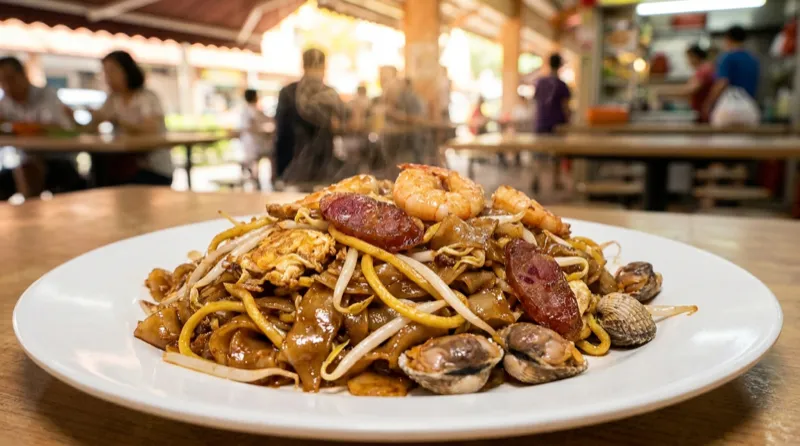
Char kway teow is one of Singapore's most beloved hawker dishes — flat rice noodles tossed in a screaming-hot wok with dark soy sauce, lard, prawns, cockles, Chinese sausage, bean sprouts, and egg. The charred wok aroma alone can stop you in your tracks at any hawker centre.
But it's also consistently ranked among the highest-calorie dishes you can order. A standard plate — HPB's own official 480g portion — sits at 989 calories, roughly 60 to 65% of a typical adult's daily calorie target in a single meal. And the fat content? Around 42 grams per plate, largely from lard and the intense wok frying process.
So is char kway teow off-limits if you're watching your weight? Not necessarily. Let's look at exactly where the calories come from, how stall variations affect the numbers, and how to enjoy it without derailing your goals.
Char Kway Teow Calories at a Glance
| Variant | Calories | Fat | Carbs | Protein |
|---|---|---|---|---|
| Small plate, no lard, no cockles (est.) | ~520–580 kcal | ~22g | ~68g | ~16g |
| Smaller plate, vegetable oil, no cockles (est.) | ~600–650 kcal | ~26g | ~78g | ~17g |
| Smaller plate with cockles, lighter oil (est.) | ~680–720 kcal | ~30g | ~80g | ~18g |
| Medium plate with lard and cockles (est.) | ~720–760 kcal | ~34–38g | ~82g | ~19g |
| Standard/full plate — HPB's official 480g portion (lard, cockles, sausage) | ~989 kcal | ~42g | ~125g | ~26g |
Only the standard/full-plate row is HPB's directly measured figure. The smaller-plate and lighter-oil rows above are our own estimates for how a smaller portion or oil swap would scale down from that verified base — HPB does not separately test those variations.
Where Do All the Calories Come From?
Char kway teow's calorie density is the result of multiple high-fat components cooking together at extreme heat. HPB measures char kway teow only as a whole 480g dish (989 kcal) — it does not publish a per-ingredient breakdown. The table below is our own estimated split of that verified total, built from typical recipe proportions and general ingredient calorie data, not a direct HPB lookup for each line:
| Ingredient (estimated split) | Approx. Calories | Main Impact |
|---|---|---|
| Flat rice noodles (kway teow, ~280–300g in HPB's full 480g portion) | ~380–430 kcal | High-carb base |
| Lard / cooking oil (4–5 tbsp) | ~260–320 kcal | Primary fat source |
| Dark soy sauce (2–3 tbsp) | ~20–35 kcal | High sodium (~2,000mg) |
| Egg (1 large) | ~70–80 kcal | Protein + fat |
| Prawns (4–6 medium) | ~40–60 kcal | Good protein |
| Cockles (~6–8 pieces) | ~30–50 kcal | Cholesterol |
| Chinese sausage (lup cheong, 1–2 slices) | ~50–80 kcal | Fat + sodium |
| Bean sprouts (handful) | ~10–15 kcal | Fibre, volume |
| Chives / spring onions | ~5 kcal | Negligible |
These per-ingredient figures are estimates that add up to roughly the verified 989 kcal total — only the whole-plate figure (989 kcal, 42g fat, 125g carbs, 26g protein) is HPB's directly measured value.
Stall Variations That Change the Calorie Count
Not all char kway teow is created equal. Here are the factors that cause the biggest differences between stalls:
Lard vs vegetable oil
This is the single biggest variable. Traditional hawker stalls — especially the old-school legends like those at Ghim Moh, Old Airport Road, and Outram Park — use lard for authentic wok hei. Newer or health-conscious stalls often switch to vegetable oil. If you're watching calories, ask before you order.
Portion size
Some stalls default to larger portions than others. A "regular" plate at one stall might be 20 to 30% bigger than at another. HPB's own official default portion for char kway teow weighs 480g — noticeably more generous than a stripped-down "small plate" order, which is why the full HPB-portion figure (989 kcal) sits well above the lighter variants further down this page.
Amount of cockles and sausage
Cockles and Chinese sausage are both calorie-dense for their size. More cockles = more cholesterol. More lup cheong = more fat and sodium. Asking for less of these (or omitting sausage entirely) saves 50 to 100 calories.
Wok technique and heat
A hawker with a powerful wok flame cooks faster, locking in flavour with less oil. A lower-heat cook may compensate with more oil to prevent sticking. Wok hei isn't just about taste — it genuinely affects how much oil is absorbed.
Char Kway Teow vs Other Popular Hawker Dishes
| Dish | Approx. Calories | Verdict |
|---|---|---|
| Chicken Rice (steamed) | 488 kcal | ✅ Excellent choice |
| Wonton Mee (dry, standard) | ~625 kcal | ✅ Good |
| Economy Rice (3 veg, no fried items) | ~450–550 kcal | 👍 Decent |
| Roti Prata (2 plain) | ~993 kcal | ⚠️ Heavier than it looks |
| Laksa (full bowl) | ~429 kcal | ⚠️ High sodium |
| Nasi Lemak (chicken wing set) | ~831 kcal | ⚠️ Heavy |
| Char Kway Teow (standard plate) | ~989 kcal | ❌ Occasional treat |
| Mee Goreng (fried, standard) | ~856 kcal | ⚠️ High fat + sodium |
How to Order Char Kway Teow Smarter
You don't have to give it up entirely. These small changes can shave 100 to 200 calories off a standard plate:
What About the Sodium?
Even if the calories don't alarm you, the sodium in char kway teow should. A standard plate contains approximately 1,800 to 2,400mg of sodium — the HPB recommends a maximum of 2,000mg per day for adults. One plate of char kway teow alone can hit that ceiling.
High sodium intake is linked to hypertension, a major risk factor in Singapore. The Health Promotion Board specifically lists char kway teow as one of the dishes to consume less frequently due to its high salt and fat content.
Can You Eat Char Kway Teow and Still Lose Weight?
Yes — with planning. Char kway teow is not a forbidden food; it's a high-calorie one. If you're aiming for 1,600 calories per day, a standard 989-calorie plate of CKT (HPB's official portion) leaves around 600 calories for your other two meals. That's still doable with light choices like clear soup noodles, a small bowl of congee, or a protein-rich salad — or order a lighter version (no lard, small plate) to free up more room.
The problem isn't eating char kway teow once a week. The problem is eating it twice a week without accounting for it — adding an invisible 1,400 to 1,500 calories to your week that you didn't budget for.
That's exactly where calorie tracking pays off. When you log char kway teow in NutriKaki, you see the true cost — and you can plan the rest of your day around it without guilt or guesswork.
Frequently Asked Questions
A standard plate of char kway teow in Singapore is approximately 989 calories, per HPB's official 480g portion, with around 42g of fat. Smaller portions or versions cooked without lard can come in closer to 520 to 580 calories.
Char kway teow is one of Singapore's higher-calorie hawker dishes, mainly due to the lard, dark soy sauce, and high-heat wok frying. It is high in fat and sodium. That said, enjoyed occasionally and in moderate portions, it fits into a balanced diet.
The main culprits are lard or oil used in wok frying (4 to 5 tablespoons in a full HPB-portion plate), dark soy sauce adding sodium and a small amount of sugar, and the flat rice noodles themselves contributing a large carbohydrate base. Cockles, Chinese sausage, and eggs also add fat and calories.
Yes, occasionally. If you are tracking calories, save char kway teow for days where your other meals are lighter. A standard plate at 989 kcal, per HPB's official portion, leaves room for two other meals of around 250 to 300 kcal each in a 1500-kcal diet. Use NutriKaki to log it accurately and stay on track.
Char kway teow is one of the heavier options. Chicken rice (steamed, 346g plate) is 488 kcal per HPB's official portion. Laksa is 429 kcal. Nasi lemak (chicken wing set) is 831 kcal. Char kway teow, at 989 kcal per HPB's official 480g plate, is one of the heaviest common hawker meals by HPB's own portion data.
Nutrition data sourced from the Health Promotion Board (HPB) Singapore food composition database and HPB Healthier Dining Programme guidelines. Values are approximate and vary by stall, portion size, and cooking method. This article is for general wellness purposes only and does not constitute medical or dietary advice. Nutrition data referenced in this article is used under licence from the Health Promotion Board (HPB) of Singapore and may not be redistributed, republished, or reused commercially without NutriKaki's prior written permission.