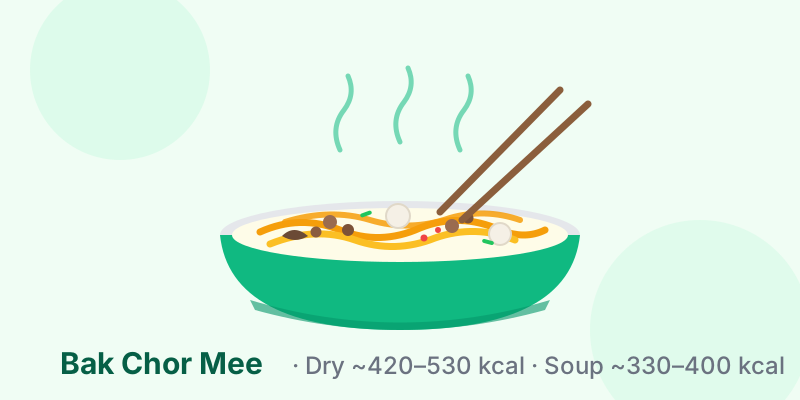
Bak Chor Mee Calories Singapore: Dry vs Soup — Full Breakdown
Bak chor mee — minced meat noodles — is arguably Singapore's most argued-about noodle dish. Everyone has a favourite stall, a preferred noodle (mee pok or mee kia), and a strong opinion on the right vinegar-to-chilli ratio. What most people don't have is a clear picture of how many calories are sitting in that bowl.
The short answer: dry bak chor mee typically contains around 563 kcal (430 g bowl), while the soup version comes in at around 539 kcal (682 g bowl) per serving — the two styles are actually close in calories, not one dramatically lighter than the other. The dry version's lard oil and sauce are offset by the soup version's larger default bowl size. This guide breaks the dish down component by component — noodles, minced pork, liver, pork balls, mushrooms, and that signature sauce — so you know exactly where the calories hide and how to trim them without ruining the dish.
Dry vs Soup Bak Chor Mee: Calorie Comparison Table
The table below compares both styles, with and without the optional extras (fried wontons, extra pork balls) that many stalls offer, so you can see which choices move the needle most.
| Serving Style | Standard Bowl | With Fried Wontons (est.) | Protein | Carbs | Fat |
|---|---|---|---|---|---|
| Dry (mee pok) | ~563 kcal (430 g bowl) | ~630–645 kcal | ~22–28 g | ~84 g | ~16–24 g |
| Soup (mee kia or mee pok) | ~539 kcal (682 g bowl) | ~605–620 kcal | ~39 g | ~74 g | ~8–13 g |
| Dry (less noodles, estimate) | ~340–440 kcal | ~410–520 kcal | ~20–26 g | ~36–46 g | ~14–22 g |
| Soup (less noodles, estimate) | ~280–330 kcal | ~350–410 kcal | ~22–28 g | ~32–42 g | ~6–11 g |
Only the "Dry" and "Soup" standard-bowl figures (563 kcal, 430 g bowl and 539 kcal) are HPB's directly measured whole-bowl values. The "With Fried Wontons" column adds HPB's separate fried wanton figure on top; the "less noodles" rows are our own estimate of a smaller noodle portion, since HPB does not publish a reduced-noodle version of this dish. Treat those as estimates built on HPB data, not direct HPB lookups.
Breaking Down Each Component
Bak chor mee is best understood as five separate elements: the noodles, the minced pork, the liver and pork balls, the braised mushrooms, and the sauce (or broth). Each contributes very differently to the final count. HPB measures bak chor mee only as two whole-bowl entries — dry (563 kcal per 430g bowl) and soup (539 kcal per 682g bowl) — it does not publish a component-by-component breakdown. The figures below are our own estimated split of those HPB totals, not individual HPB lookups.
Mee Pok or Mee Kia: The Carb Base (estimate)
A standard hawker serving uses roughly 120 to 150 g of cooked flat mee pok or thin mee kia, contributing around 190 to 230 kcal (estimate) — nearly all from refined carbohydrates. The two noodle types are calorically almost identical; the choice is texture, not nutrition. As with wonton mee, the noodles pick up extra fat in the dry version when they are tossed with lard oil after blanching.
Minced Pork: The Lean(ish) Core (estimate)
The signature minced pork is typically an 80 to 100 g portion, adding approximately 90 to 130 kcal (estimate) depending on the fat ratio of the mince. Most stalls use a moderately fatty blend for flavour and tenderness. It delivers around 12 to 16 g of protein, making it one of the more efficient protein sources in the bowl.
Pork Liver: Tiny Calories, Big Nutrients (estimate)
The 2–3 slices of pork liver in a standard bowl add only 30 to 45 kcal (estimate), while packing meaningful amounts of iron, vitamin A, and vitamin B12. Per calorie, liver is one of the most nutrient-dense items in Singapore hawker food. The caveats: it is high in cholesterol and purines, so people managing gout should ask for it to be left out — see our gout-friendly hawker guide for more on that.
Pork Balls and Fishballs (estimate)
Most bowls come with 2 to 4 pork balls or fishballs, adding around 50 to 90 kcal (estimate). Fishballs are slightly leaner than pork balls (roughly 20–25 kcal each versus 25–35 kcal). They are a reasonable component to keep — the bigger savings are elsewhere.
Braised Mushrooms (estimate)
The braised shiitake mushrooms contribute around 25 to 45 kcal (estimate), mostly from the soy-and-sugar braising liquid rather than the mushrooms themselves. Some stalls spoon extra braising sauce over the noodles, which nudges both calories and sodium upward.
The Sauce (Dry) vs The Broth (Soup) — estimate
Dry style: The tossing sauce — lard oil, black vinegar, chilli, and sometimes ketchup or braising liquid — contributes an estimated 80 to 130 kcal (estimate). The black vinegar itself is nearly calorie-free; the lard oil and crispy lard croutons (bak you phok) carry almost all of the load. A generous scattering of crispy lard alone can add 40 to 60 kcal.
Soup style: The pork-bone and ti poh (dried sole fish) broth adds roughly 25 to 45 kcal (estimate) per bowl — calorically light, but sodium is the real concern. HPB's measured whole-bowl sodium for soup bak chor mee is about 2,135 mg per bowl (dry is about 1,620 mg) — both already well over the 2,000 mg daily recommended limit on their own. Flavour-wise you keep the minced pork, liver, and mushrooms; you simply skip the lard toss.
Why Estimates for Bak Chor Mee Vary So Widely
If you have searched for bak chor mee calories before, you may have seen figures anywhere from 400 to over 700 kcal. The variation is real, not sloppy data. Stalls differ enormously in lard usage, mince fat ratio, and extras — a bowl loaded with fried wontons, extra crispy lard, and a fattier mince can genuinely approach 700 kcal, while a restrained soup version sits below 350 kcal. That is exactly why generic global food databases struggle with this dish: a single crowdsourced entry cannot represent a dish this variable. Portion-calibrated local data, like the HPB figures NutriKaki uses, gets you much closer.
How to Order Smarter at the Hawker Centre
You can realistically save 100 to 200 kcal on a bowl of bak chor mee with a few small requests — none of which will earn you a glare from the uncle.
- Ask for less lard oil or no lard (少猪油). The single highest-impact request for the dry version. Estimated saving: 60–100 kcal.
- Skip the crispy lard bits and fried wontons. Together they can add 100–140 kcal of almost pure fat and refined carbs.
- Request half portion noodles (半份面). Saves roughly 80–110 kcal and leaves the protein components untouched.
- Choose soup over dry if you want less sodium, not fewer calories. The two styles are close in calories (roughly 24 kcal apart) — the real reason to pick soup is to avoid the lard-and-vinegar toss, not to cut calories. Keep the vinegar-chilli dip on the side if you miss the tang.
- Keep the liver, mince, and mushrooms. These are the nutrient-dense, calorie-reasonable parts of the dish. The lard and fried extras are where the empty calories live.
- Don't finish the broth. If you order soup, leaving the last third of the bowl meaningfully cuts your sodium load for the day.
Comparing Bak Chor Mee to Other Hawker Noodle Dishes
| Hawker Dish | Approx. Calories (standard serving) | Notes |
|---|---|---|
| Bak chor mee (dry) | ~563 kcal (430 g bowl) | Lard oil and sauce drive the count |
| Bak chor mee (soup) | ~539 kcal (682 g bowl) | Close to dry in calories; watch the sodium |
| Dry wonton mee | ~625 kcal (388 g bowl) | Similar range; char siew adds sugar |
| Char kway teow | ~989 kcal (480 g plate) | Wok hei, lard, and cockles add up fast |
| Laksa | ~429 kcal (604 g bowl) | Coconut-heavy gravy, but a smaller bowl than you'd think |
| Fishball noodle soup | ~519 kcal (798 g bowl) | Broth-based, but not dramatically lighter than bak chor mee |
In context, bak chor mee — dry or soup — sits well below char kway teow and close to dry wonton mee, but it is not dramatically higher than the other soup-based noodle dishes here. Laksa's coconut gravy has a reputation as the calorie-heavy option, but HPB's reference bowl for it is smaller than a typical bak chor mee serving, so it actually comes out lower per bowl. The lesson: bowl size and recipe matter more than the dish category. The soup version of bak chor mee is still one of the better protein-per-calorie deals at the noodle stall.
Tracking Bak Chor Mee with NutriKaki
Bak chor mee is one of the dishes you can log directly in NutriKaki, Singapore's hawker-first calorie tracker powered by HPB food composition data. Instead of hunting through a global database for a crowdsourced entry that may describe a completely different bowl, NutriKaki surfaces values calibrated to actual Singapore hawker portions — dry or soup, with adjustable serving sizes for half noodles or extra pork balls.
Log your bowl in seconds, and the app shows where you stand against your daily calorie and macro targets for the rest of the day.
Frequently Asked Questions
A standard hawker serving of dry bak chor mee (mee pok style) contains approximately 563 kcal, based on HPB's default 430g bowl. The exact figure depends on how much lard oil is tossed through the noodles, the portion of minced pork and liver, and whether fried wontons or extra pork balls are included.
Only slightly. Soup bak chor mee runs about 539 kcal per bowl (based on HPB's default 682g bowl) versus about 563 kcal for dry — a gap of roughly 24 kcal, which is close enough that calories alone shouldn't decide your order. The soup style skips the lard-and-vinegar sauce that the noodles are tossed in, but the larger broth volume makes up much of the difference. The real trade-off is sodium: HPB measures the whole soup bowl at about 2,135 mg (dry is about 1,620 mg) — both already over the 2,000 mg daily recommended limit on their own.
The signature sauce — lard oil, black vinegar, chilli, and sometimes ketchup or mushroom braising liquid — contributes an estimated 80 to 130 kcal per serving. The black vinegar itself is nearly calorie-free; it is the lard oil and crispy lard croutons that carry most of the load.
A typical 2–3 slice portion of pork liver adds only 30 to 45 kcal and is rich in iron, vitamin A, and vitamin B12. However, liver is high in cholesterol and purines, so people managing gout or cholesterol may want to skip it. For most people, it is a nutrient-dense, low-calorie component.
The highest-impact changes: ask for less lard oil or no lard (saves 60–100 kcal), skip the fried wontons or crispy lard bits, request half portion noodles (saves roughly 80–110 kcal), and choose the soup version over dry. A soup bak chor mee with half noodles can come in around 280 to 330 kcal.
Calorie values are estimates based on HPB Singapore food composition data and standard Singapore hawker serving sizes. Actual values vary by stall, portion size, and cooking method. This content is for general informational purposes only and does not constitute medical or dietary advice. Consult a registered dietitian for personalised nutrition guidance. Nutrition data referenced in this article is used under licence from the Health Promotion Board (HPB) of Singapore and may not be redistributed, republished, or reused commercially without NutriKaki's prior written permission.