Coconut Nutrition Guide: Calories in Every SG Coconut Food
Coconut is everywhere in Singapore food, and it rarely looks the same twice. It's the water inside a chilled young coconut at the hawker centre. It's the rich gravy in your laksa. It's the shredded topping on tutu kueh, the filling in a coconut bun, the base of a Thai dessert stall's coconut ice cream. Same fruit, wildly different calorie stories depending on how it's processed and how much of it actually ends up in your bowl.
That's the tricky part — "coconut" isn't one ingredient. Fresh flesh, thick milk, thin milk, cream, desiccated coconut and coconut water all come from the same source but behave completely differently nutritionally. This guide walks through each form using HPB Singapore's food composition database, so you can tell the difference between a splash of coconut milk in your soup and a whole bowl of coconut-based dessert.
Coconut Forms at a Glance (per 100g/100ml)
All figures are per 100g or 100ml of the raw ingredient, not per serving. See the sections below for realistic serving-size translations.
Coconut Water: The Actual Low-Calorie Option
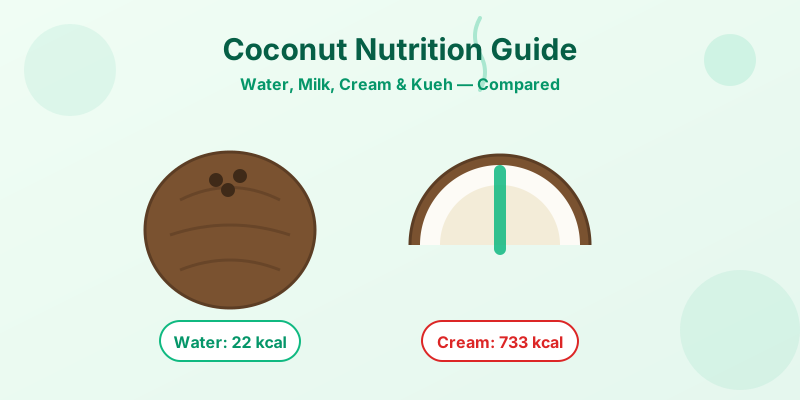
Fresh coconut water is genuinely light — about 22 kcal per 100ml, essentially all from natural sugar (5.6g per 100ml), with no fat. A whole young coconut typically pours out around 250-350ml of water, so drinking straight from the fruit works out to roughly 55-77 kcal — less than most fruit juices and far less than a sweetened bottled drink.
Packaged coconut water runs even lower per 100ml (18-20 kcal), since it's usually diluted or reconstituted, though it can carry more sodium from processing — packaged versions range from 14-29mg sodium per 100ml versus just 1mg for fresh. If you want the full breakdown of every packaged coconut water and coconut-based shake variant, we've covered that separately.
Coconut Milk: Why "Thick" and "Thin" Aren't the Same Ingredient
This is the one that trips people up when cooking. Thick coconut milk and thin coconut milk come from the exact same grated coconut flesh — thick is the first press, squeezed straight out with minimal added water, while thin is the second press, made by adding water back to the same flesh and squeezing again. The result: thick milk is 245 kcal per 100ml with 24.7g of fat, while thin milk is 99 kcal per 100ml with 10.3g of fat — less than half.
| Coconut Extract | Calories /100ml | Fat | How It's Used |
|---|---|---|---|
| Thin coconut milk | 99 kcal | 10.3g | Larger quantities — soups, lighter gravies |
| Thick coconut milk | 245 kcal | 24.7g | Small quantities — rich curries, kueh, desserts |
| Coconut cream | 733 kcal | 69.0g | Splashed in — laksa gravy, rendang, drizzled toppings |
This is also why a recipe tells you to use thin milk for soup-based dishes and thick milk (or cream) for rich, clingy gravies — it's about texture and richness, not just calories. Using thick milk everywhere would make every dish taste heavier than intended, and using thin milk in a rendang would leave it watery.
Fresh Flesh vs Desiccated Coconut
Fresh mature coconut flesh is 354 kcal per 100g, with 33.5g of fat (mostly saturated) and a useful 9g of fibre. Desiccated coconut — the dried, shredded stuff sprinkled on kueh — reads much higher at 660 kcal per 100g, simply because drying removes the water content and concentrates everything else. Don't panic at that number: desiccated coconut is a garnish, not a serving. A tablespoon (roughly 5-8g) works out to about 33-53 kcal, which is a rounding error next to the kueh itself.
SG Coconut Snacks & Desserts Compared
| Item | Calories /100g | Fat | Sugar | Notes |
|---|---|---|---|---|
| Sea coconut dessert | 55 kcal | 0.0g | 9.1g | Crushed ice + canned sea coconut (attap fruit, not real coconut) |
| Sea coconut (preserved, in syrup) | 86 kcal | 0.0g | 14.1g | Sweet attap-palm fruit, often mistaken for coconut |
| Thai tapioca with coconut milk | 116 kcal | 2.1g | 8.2g | Boiled tapioca pearls in light coconut milk |
| Thai coconut ice cream with toppings | 115 kcal | 9.2g | 4.5g | Rich in fat relative to its modest calorie count |
| Min jiang kueh (coconut) | 194 kcal | 4.3g | 8.6g | Pan-cooked thick pancake, coconut filling |
| Chutney (coconut) | 106 kcal | 7.9g | 0.3g | Braised Indian-style condiment, eaten in small spoonfuls |
| Tutu kueh (coconut) | 307 kcal | 8.7g | 19.0g | Steamed rice flour cake with coconut-sugar filling |
| Coconut bun | 385 kcal | 21.2g | 18.0g | Baked bun with sweetened coconut filling |
The pattern here is straightforward: desserts that are mostly ice, water or tapioca (sea coconut dessert, Thai tapioca) stay light because coconut is a minority ingredient. Baked and steamed items — coconut bun, tutu kueh — pack more calories because they combine flour, sugar and coconut filling into a dense, compact snack.
Practical Tips for Eating Coconut Without Overdoing It
Frequently Asked Questions
Thick coconut milk (first-press) is about 245 kcal per 100ml, while thin coconut milk (second-press) is about 99 kcal per 100ml. But most dishes use both in small amounts mixed into a large pot of curry or soup, so the calories you actually eat per bowl are much lower than the per-100ml figure suggests — it's the total gravy volume that matters, not the headline number.
Fresh coconut water is only about 22 kcal per 100ml, making it one of the lowest-calorie drinks available at a hawker centre. A typical 300ml young coconut serves up roughly 66 kcal, mostly from natural sugar. It's not a fat-burning drink, but as a low-calorie swap for sugary bottled drinks, it's a reasonable choice.
660 kcal per 100g sounds alarming, but desiccated coconut is a dried garnish used a tablespoon at a time on kueh or desserts, not eaten by the bowlful. A tablespoon (roughly 5-8g) works out to about 33-53 kcal — the high per-100g number simply reflects that drying removes water and concentrates the fat and calories.
Thick coconut milk is the first extraction squeezed from grated coconut flesh, richer and fattier, used in small quantities for rich curries and desserts like laksa or bubur. Thin coconut milk is the second extraction from the same flesh (after more water is added and squeezed again), lighter and used in larger quantities for soups and lighter gravies. They come from the same coconut — the difference is concentration, not ingredient.
No. Despite the name, sea coconut is the fruit of the attap palm (also called ice jelly or attap chee), not a coconut at all. It's usually sold preserved in sweet syrup, at about 86 kcal per 100g, or made into a crushed-ice dessert at about 55 kcal per 100g. It shares no relation to actual coconut flesh, milk or water.
Nutrition data sourced from the Health Promotion Board (HPB) Singapore food composition database. Calorie values are approximate and vary by brand, preparation and portion size. This article is for general wellness information only and does not constitute medical or dietary advice. Consult a registered dietitian for personalised nutrition guidance. Nutrition data referenced in this article is used under licence from the Health Promotion Board (HPB) of Singapore and may not be redistributed, republished, or reused commercially without NutriKaki's prior written permission.