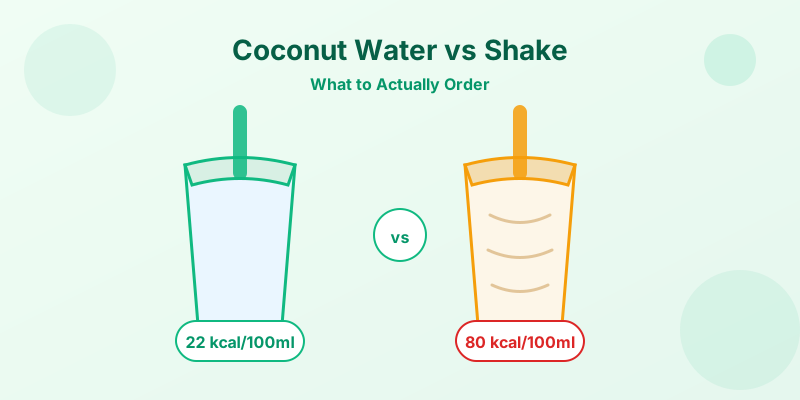
Coconut Shakes vs Coconut Water: What to Actually Order
Coconut water and coconut shake sit next to each other on the same drink stall menu, both looking equally "natural" and "healthy." They are not the same drink. One is basically the water inside a coconut. The other is blended coconut flesh, often with condensed milk or sugar syrup, sometimes with avocado, sometimes with toppings on top of that.
If you're choosing between them thinking they're roughly interchangeable, you're leaving calories on the table — or rather, in the cup. This guide uses HPB Singapore data to lay out exactly how far apart these drinks really are, so you can order the one you actually want to be drinking.
Coconut Drinks at a Glance (per 100ml)
All figures are per 100ml — see the real-world serving size section below for what this means per cup.
All the Coconut Water Variants
| Coconut Water Type | Calories /100ml | Sugar | Sodium | Verdict |
|---|---|---|---|---|
| Packaged coconut water | 18 kcal | 3.4g | 29mg | ✅ Lowest calorie |
| Coconut water, less sugar (packaged) | 19 kcal | 4.0g | 14mg | ✅ Very light |
| Flavoured coconut water (packaged) | 20 kcal | 4.45g | 24mg | ✅ Very light |
| Coconut water, fresh (from the fruit) | 22 kcal | 5.6g | 1mg | 👍 Lowest sodium |
| Flavoured coconut juice drink | 34 kcal | 7.7g | 1mg | ⚠️ More sugar added |
| Coconut juice with pulp (packaged) | 38 kcal | 8.5g | 25mg | ⚠️ Highest of this group |
Every coconut water variant sits in a tight 18-38 kcal per 100ml band — genuinely low regardless of which one you grab. Fresh coconut water has the least sodium by far (1mg vs 14-29mg for packaged), since nothing has been added during processing. Coconut juice with pulp and flavoured coconut juice drink are the two to watch if you're minimising sugar, since both have sugar added on top of the coconut's own natural sugar.
All the Shake Variants
| Shake Type | Calories /100ml | Fat | Sugar | Verdict |
|---|---|---|---|---|
| Coconut shake, no sugar (no topping) | 55 kcal | 2.86g | 4.31g | ⚠️ Still 2.5x coconut water |
| Coconut shake, less sugar (no topping) | 64 kcal | 2.8g | 6.4g | ⚠️ Moderate |
| Coconut shake, regular (no topping) | 75 kcal | 2.93g | 9.05g | ❌ Over 3x coconut water |
| Coconut avocado shake, no sugar (no topping) | 71 kcal | 3.87g | 6.38g | ❌ Avocado fat adds up |
| Coconut avocado shake, less sugar (no topping) | 74 kcal | 4.02g | 7.0g | ❌ Highest fat of the set |
| Coconut avocado shake, regular (no topping) | 80 kcal | 4.8g | 6.57g | ❌ Highest calorie of the set |
Two things stand out. First, even the leanest shake option — coconut shake, no sugar, no topping — is still 55 kcal per 100ml, well above any coconut water variant. Second, adding avocado doesn't reliably lower calories or fat the way it might if you're picturing "healthy fats replacing sugar" — coconut avocado shake actually runs slightly higher in both fat and calories than a plain coconut shake at every sugar level. And all of these figures are for the no-topping version — actual toppings (which we don't have data for here) would push every shake number higher still.
What This Actually Looks Like Per Cup
HPB's figures are per 100ml, but nobody drinks 100ml. A typical hawker-stall coconut drink cup is roughly 300ml. Scaling up (this is our own rough approximation, not an official HPB per-serving figure) gives you a clearer sense of the real gap:
| Drink (approx. 300ml cup) | Approx. Calories | vs Coconut Water |
|---|---|---|
| Coconut water, fresh | ~66 kcal | Baseline |
| Coconut juice with pulp | ~114 kcal | +48 kcal |
| Coconut shake, no sugar | ~165 kcal | +99 kcal |
| Coconut shake, regular | ~225 kcal | +159 kcal |
| Coconut avocado shake, no sugar | ~213 kcal | +147 kcal |
| Coconut avocado shake, regular | ~240 kcal | +174 kcal |
On this approximation, a regular coconut avocado shake works out to roughly 3.6 times the calories of plain coconut water for the same cup size — before any toppings like grass jelly, nata de coco or extra syrup are added on top.
How to Order Coconut Drinks Smarter
Frequently Asked Questions
Fresh coconut water is the lowest, at about 22 kcal per 100ml with zero fat. A typical 300ml young coconut works out to roughly 66 kcal. Packaged coconut water is similar or slightly lower per 100ml (18-20 kcal), though it usually carries more sodium from processing.
No, coconut shake is meaningfully higher in calories and fat than plain coconut water. Even a no-topping, no-sugar coconut shake is about 55 kcal per 100ml with 2.9g of fat, versus 22 kcal and 0g fat for coconut water — roughly 2.5x the calories before any topping is added.
No. A no-sugar, no-topping coconut shake still comes in at about 55 kcal per 100ml with 2.86g of fat and 4.31g of sugar. "No sugar" removes the added sugar syrup, but it doesn't remove the natural fat and sugar already present in blended coconut.
Avocado does add heart-healthy monounsaturated fat, but it also adds calories. Coconut avocado shake (no topping) is about 80 kcal per 100ml versus 75 kcal per 100ml for a plain coconut shake — slightly higher, not lower. Any added topping would push both further up.
Calorie-wise they're nearly identical — fresh is about 22 kcal per 100ml and packaged versions run 18-20 kcal per 100ml. The real difference is sodium: fresh coconut water has about 1mg of sodium per 100ml, while packaged versions carry 14-29mg per 100ml due to processing.
Nutrition data sourced from the Health Promotion Board (HPB) Singapore food composition database. Calorie values are approximate and vary by brand, preparation and portion size. This article is for general wellness information only and does not constitute medical or dietary advice. Consult a registered dietitian for personalised nutrition guidance. Nutrition data referenced in this article is used under licence from the Health Promotion Board (HPB) of Singapore and may not be redistributed, republished, or reused commercially without NutriKaki's prior written permission.