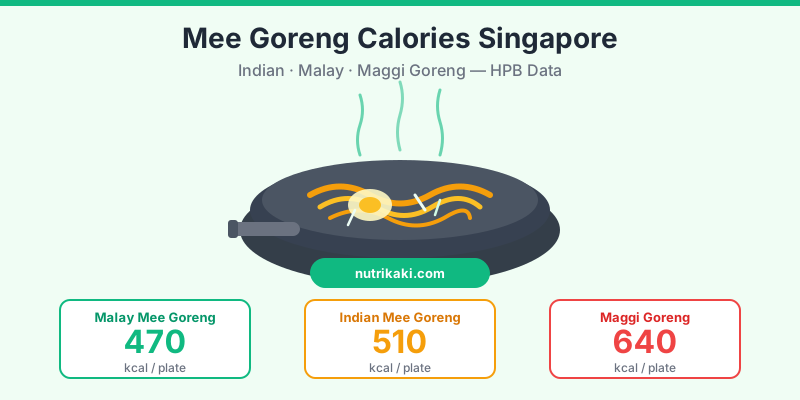
Mee Goreng Calories Singapore: Indian, Malay & Maggi Goreng Compared
Mee goreng is one of Singapore's most popular hawker plates — a fragrant, wok-tossed pile of yellow noodles with egg, vegetables, and a tangy spiced sauce. It looks like comfort food, and it is. It's also a genuinely heavy dish, heavier than most people assume — not the "moderate" option it's sometimes made out to be.
According to HPB Singapore's own food composition database, a standard plate of mee goreng comes in at approximately 856 calories (465 g plate). HPB does not keep separate verified figures for Indian-style versus Malay-style mee goreng — both fall under the same reference plate — so treat any specific split between the two as an estimate. Order Maggi goreng — made with instant noodles instead of fresh yellow noodles — and you're likely looking at something heavier still, though HPB has no separately tested figure for that version either.
This guide breaks down every common version using HPB Singapore data so you can make sense of what you're actually eating — and how to adjust your order without giving up the dish entirely.
Mee Goreng Calories at a Glance
*HPB has no separately verified entry for Maggi goreng or for Indian vs. Malay mee goreng specifically. Estimates are extrapolated from the HPB 856 kcal (465 g plate) reference plate, not independently tested.
The Full Calorie Breakdown
| Mee Goreng Variant | Calories (per plate) | Key Difference | Verdict |
|---|---|---|---|
| Mee Goreng (Malay or Indian style) | 856 kcal | HPB's reference plate (465g) — no separate figure by style | ⚠️ Heavier than it looks |
| Indian Mee Goreng (with mutton) | ~900–960 kcal (est.) | Mutton adds meaningful protein and fat on top of the base plate | ⚠️ Heavier still |
| Mee Goreng + Extra Egg | ~925 kcal (est.) | Second egg adds roughly 70 kcal | ⚠️ Watch the adds |
| Maggi Goreng (standard, est.) | ~950–1,050 kcal (est.) | Instant noodles: higher carbs, oil, and sodium — no separate HPB entry | ❌ Heaviest common version |
| Maggi Goreng + Cheese (est.) | ~1,050–1,150 kcal (est.) | Processed cheese adds further fat and calories | ❌ Very high calorie |
Only the base 856 kcal (465 g plate) figure is directly an HPB figure. All other rows are estimates built on top of it, since HPB does not test these specific variants separately.
What Makes Up the Calories in Mee Goreng?
Understanding the calorie split in a standard 856 kcal (465 g plate) plate helps you see where the biggest savings are possible:
| Ingredient | Approx. Calories | Notes |
|---|---|---|
| Yellow egg noodles (hawker portion) | ~350–400 kcal | The main calorie base — refined carbs |
| Cooking oil (wok toss) | ~150–200 kcal | Varies hugely by hawker — biggest variable |
| Egg (1 whole, folded in) | ~70–90 kcal | ✅ Adds meaningful protein |
| Bean sprouts + cabbage | ~15–25 kcal | ✅ Almost free — request extra |
| Spiced sauce (tomato, chilli, soy) | ~50–70 kcal | Sugar and oil-based — adds up fast |
| Protein add (tofu, squid, prawn, etc.) | ~90–130 kcal | Deep-fried tofu and seafood both absorb oil |
| Sambal chilli (1 tbsp) | ~25–40 kcal | Most people take 2–3 tbsp without thinking |
Component figures are approximate splits of the HPB 856 kcal (465 g plate) total. Maggi goreng swaps the noodle row for a heavier instant-noodle block and typically uses more oil — see below.
The oil used in the wok toss is a major variable, but even a light-handed stall's mee goreng still starts from a genuinely large noodle and oil base — this isn't a dish where "less oil" alone gets you to a low-calorie result. The same plate of mee goreng can vary by 100 to 150 kcal just from oil differences between stalls.
Indian vs Malay Mee Goreng: What's the Difference?
Both versions use yellow egg noodles stir-fried in a wok, but the sauce base is quite different — and that affects flavour more clearly than it affects calories. Importantly, HPB's food composition database does not maintain separate verified entries for Indian-style and Malay-style mee goreng — both are covered by the same 856 kcal (465 g plate) reference plate. Any specific split you see between the two (including elsewhere on this page) is a reasonable estimate, not an independently tested figure.
Indian mee goreng (mee goreng mamak) uses a thick tomato and spiced chilli sauce, often with squid, prawns, or tofu. The sauce tends to be richer and more oily, which may push it toward the higher end of a plausible range around the HPB 856 kcal (465 g plate) baseline.
Malay mee goreng uses a darker, sweeter kecap manis (sweet soy sauce) base and typically comes with bean sprouts, egg, and cabbage. It may run slightly lighter in practice due to more vegetables and less oily sauce, but without a separate HPB entry, treat any gap between the two styles as a rough estimate rather than a verified difference.
Why Maggi Goreng Is Likely Even Heavier
Maggi goreng replaces the fresh yellow noodles with a block of instant Maggi noodles — and this swap likely pushes the dish's calories higher still. HPB does not have a separately tested entry for Maggi goreng, but instant noodle blocks are generally higher in calories, oil, and refined carbohydrate than the same weight of fresh yellow noodles, and stalls serving it often use more oil in the wok toss as well.
Beyond calories, instant noodles are typically much higher in sodium — the seasoning packet alone can contain 800–1,000 mg. Most hawker stalls don't use the full packet, but even partial use adds meaningfully on top of a dish that, in its standard form, already carries around 3,050mg of sodium.
The flavour of Maggi goreng is uniquely satisfying — nobody is saying don't eat it. But treat any specific calorie figure for it as an unverified estimate, and assume it's a heavier plate than standard mee goreng, not a lighter one.
Full Macronutrient Profile: Standard Plate
| Nutrient | Mee Goreng, Malay or Indian (856 kcal, 465 g plate, HPB) | Maggi Goreng (~950+ kcal, estimate) |
|---|---|---|
| Calories | 856 kcal (465 g plate) | ~950–1,050 kcal (est.) |
| Carbohydrates | 111g | ~120–135g (est.) |
| Protein | 26.5g | ~24–28g (est.) |
| Fat (total) | 34g | ~38–45g (est.) |
| Sodium | 3,050mg | ~3,200–3,600mg (est.) |
| Fibre | ~3–5g | ~2–4g (est.) |
Only the Mee Goreng column is directly an HPB figure. HPB does not maintain separate figures for Malay vs. Indian style, or for Maggi goreng — the latter's figures are estimates built on top of the HPB base plate.
How to Order Mee Goreng Smarter
Mee Goreng vs Other Popular Hawker Noodles
| Hawker Noodle Dish | Approx. Calories | Verdict |
|---|---|---|
| Mee Soto (soup) | ~380–430 kcal | ✅ Lightest noodle option |
| Mee Rebus | ~520–560 kcal | ⚠️ Thick gravy is deceptively high |
| Mee Goreng (Malay or Indian) | 856 kcal (465 g plate) | ❌ Heavier than most people assume |
| Fried Hokkien Mee (Singapore style) | 830 kcal (549 g plate) | ❌ Comparable to mee goreng |
| Char Kway Teow (with lard) | 989 kcal (480 g plate) | ❌ Highest calorie fried noodle here |
| Maggi Goreng (est.) | ~950–1,050 kcal (est.) | ❌ Likely the heaviest common version |
Mee goreng sits toward the heavier end of the fried noodle spectrum — close to fried hokkien mee, and not far behind char kway teow. It is not one of the "lighter" fried noodle choices at a hawker centre; if you're watching calories, portion control and add-ons matter more here than picking mee goreng over its rivals.
Is Mee Goreng Good for Weight Loss?
At 856 calories (465 g plate) for a standard plate, mee goreng is a significant chunk of most people's daily calorie budget in one meal — this is not a dish to treat as a light lunch option. It can still fit into a calorie-controlled day, but it needs to be planned around, not treated as a default choice, especially if you're pairing it with a sugary teh tarik or fried sides.
Sodium is just as much of a concern as the calories here. At approximately 3,050mg per plate, a single serving of mee goreng already exceeds the entire 2,000mg daily recommended sodium limit. If you eat mee goreng regularly, the "少油 (less oil)" request and skipping extra sambal help, but they won't bring either number down to "light meal" territory on their own — portion size is the biggest lever.
The protein content — around 26.5g from the egg, tofu, and any added protein — is a genuine positive. A meal with that much protein is filling, which at least means you're less likely to snack later in the afternoon, even if the calorie and sodium totals mean it should be an occasional plate rather than a daily one.
Frequently Asked Questions
A standard plate of mee goreng in Singapore contains approximately 856 calories, based on HPB Singapore's own 465g reference plate. HPB does not keep separate figures for Malay vs. Indian style — both fall under this same reference — and Maggi goreng is likely heavier still, though HPB has no separately verified figure for it.
Mee goreng is actually one of the heavier popular fried hawker dishes, not a moderate one. HPB's data puts a standard 856 kcal (465 g plate) plate close to char kway teow (989 kcal, 480 g plate) and fried hokkien mee (830 kcal, 549 g plate). The main health concern is sodium — a typical plate contains approximately 3,050mg, well over the full daily recommended limit. Eating it occasionally, asking for less oil, and watching portion size make it a more reasonable part of a balanced diet.
HPB does not have a separately verified entry for Maggi goreng. Since it starts from an already-heavy base (standard mee goreng is 856 kcal, 465 g plate) and instant noodle blocks tend to add further oil and carbohydrate, a reasonable estimate is upward of 950 kcal per plate — treat this as an estimate, not an HPB-tested figure. Maggi goreng with added cheese would be higher still.
Indian mee goreng uses a tomato and spiced chilli base, often with squid, prawns, or tofu. Malay mee goreng uses a sweeter kecap manis (sweet soy) sauce with more vegetables like bean sprouts and cabbage. HPB's database does not separate the two — both are covered by the same 856 kcal (465 g plate) reference plate — so any specific calorie gap between them is an estimate rather than a verified figure.
The most impactful changes are asking for less oil (少油 or "sikit minyak"), requesting extra vegetables, going easy on sambal chilli, choosing fresh yellow noodles over Maggi, and — most importantly given how heavy a full plate already is — asking for a smaller portion or sharing. These adjustments can collectively save meaningful calories and sodium without losing the flavour you're after, but won't turn an 856 kcal (465 g plate) dish into a genuinely light one.
Nutrition data sourced from the Health Promotion Board (HPB) Singapore food composition database. Calorie values are approximate and vary by stall, oil quantity, portion size, and ingredients used. Sodium and macronutrient figures are estimates. This article is for general wellness information only and does not constitute medical or dietary advice. Consult a registered dietitian for personalised nutrition guidance. Nutrition data referenced in this article is used under licence from the Health Promotion Board (HPB) of Singapore and may not be redistributed, republished, or reused commercially without NutriKaki's prior written permission.