Porridge Calories in Singapore: Fish, Chicken, Century Egg & Duck Porridge
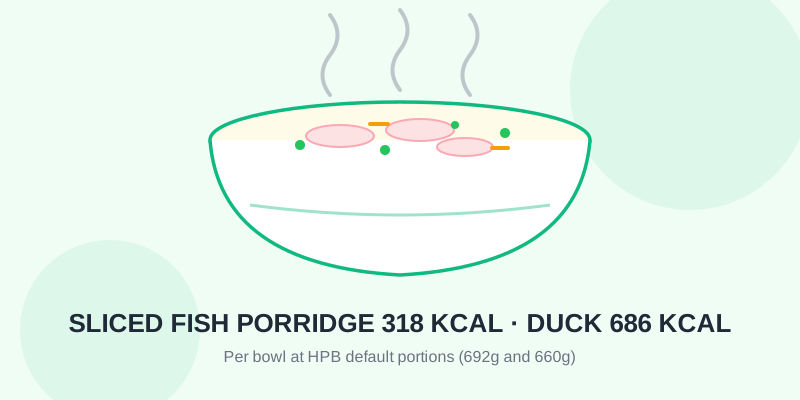
The direct answer: a bowl of sliced fish porridge is 318 kcal on HPB Singapore's data — HPB's default 692g bowl — with 18.2g of protein and 1,861mg of sodium. Chicken porridge is 311 kcal (556g bowl), century egg and pork porridge is 289 kcal (489g bowl) and duck porridge is 686 kcal (660g bowl), the heaviest on HPB's list.
Plain Teochew porridge is 251 kcal for HPB's default 660g bowl, before any sides. Porridge looks light because it is mostly water — 38 to 104 kcal per 100g across HPB's entries — but hawker bowls are big, and most of them carry 1,200mg to 2,500mg of sodium. Every figure is below.
Hawker Porridge, Per Bowl
How to read this table: each row is one bowl at HPB's own default portion, with the gram weight shown. Bowl sizes differ between entries, so compare the per-100g table further down for a like-for-like view. Nothing here is estimated.
| Porridge (HPB default bowl) | Calories | Protein | Fat | Carbs | Sodium |
|---|---|---|---|---|---|
| Teochew porridge, sweet potato — 565g bowl | 102 kcal | 4.5g | 1.1g | 18.4g | Trace |
| Teochew porridge, plain — 660g bowl | 251 kcal | 7.9g | 2.0g | 50.8g | 462mg |
| Century egg and pork porridge — 489g bowl | 289 kcal | 12.4g | 11.7g | 32.8g | 1,262mg |
| Vegetarian brown rice porridge — 660g bowl | 297 kcal | 10.9g | 5.5g | 51.1g | 1,531mg |
| Chicken porridge — 556g bowl | 311 kcal | 15.6g | 10.3g | 38.9g | 1,434mg |
| Sliced fish porridge — 692g bowl | 318 kcal | 18.2g | 5.5g | 49.5g | 1,861mg |
| Minced pork porridge — 593g bowl | 356 kcal | 14.2g | 12.5g | 47.4g | 1,577mg |
| Claypot porridge, plain — 660g bowl | 383 kcal | 7.0g | 14.8g | 54.4g | 1,399mg |
| Fried fish porridge — 660g bowl | 455 kcal | 29.6g | 15.2g | 49.5g | 2,257mg |
| Peanut and pork porridge — 710g bowl | 526 kcal | 21.7g | 22.7g | 58.3g | 1,598mg |
| Cuttlefish porridge — 660g bowl | 548 kcal | 11.2g | 5.9g | 113.5g | 1,261mg |
| Claypot frog porridge — 660g bowl | 554 kcal | 35.8g | 25.0g | 45.5g | 2,495mg |
| Duck porridge — 660g bowl | 686 kcal | 65.3g | 19.8g | 61.4g | 1,465mg |
Per 100g: why the bowl size matters more than the topping
Because bowl sizes differ, here is HPB's per-100g figure for each porridge. These are per 100g of porridge, not per bowl.
| Porridge (per 100g) | Calories | Protein | Sodium |
|---|---|---|---|
| Teochew porridge, sweet potato | 18 kcal | 0.79g | Trace |
| Teochew porridge, plain | 38 kcal | 1.2g | 70mg |
| Vegetarian brown rice porridge | 45 kcal | 1.65g | 232mg |
| Sliced fish porridge | 46 kcal | 2.63g | 269mg |
| Chicken porridge | 56 kcal | 2.8g | 258mg |
| Claypot porridge, plain | 58 kcal | 1.06g | 212mg |
| Century egg and pork porridge | 59 kcal | 2.53g | 258mg |
| Minced pork porridge | 60 kcal | 2.4g | 266mg |
| Fried fish porridge | 69 kcal | 4.49g | 342mg |
| Peanut and pork porridge | 74 kcal | 3.05g | 225mg |
| Cuttlefish porridge | 83 kcal | 1.7g | 191mg |
| Claypot frog porridge | 84 kcal | 5.43g | 378mg |
| Duck porridge | 104 kcal | 9.9g | 222mg |
Per 100g, sliced fish porridge (46 kcal) is barely heavier than plain Teochew porridge (38 kcal) — it only reaches 318 kcal a bowl because HPB's default fish porridge bowl is the biggest on the list, at 692g. Century egg and pork porridge looks lighter per bowl (289 kcal) than chicken porridge (311 kcal), but per 100g it is slightly denser (59 against 56 kcal); its HPB bowl is just smaller, at 489g against 556g. If your stall's bowl is bigger, scale it with the per-100g number.
Porridge vs Rice
Porridge is rice cooked in a lot of water, so per 100g it is much lighter than rice: HPB records plain Teochew porridge at 38 kcal per 100g against 130 kcal per 100g for cooked white rice. But per bowl, most of that gap disappears.
| Base (HPB default bowl) | Calories | Carbs | Protein | Sodium |
|---|---|---|---|---|
| Teochew porridge, plain — 660g bowl | 251 kcal | 50.8g | 7.9g | 462mg |
| Cooked white rice — 200g bowl | 260 kcal | 56.4g | 5.4g | 2mg |
| Teochew porridge, sweet potato — 565g bowl | 102 kcal | 18.4g | 4.5g | Trace |
A full 660g bowl of plain Teochew porridge is within 9 kcal of a 200g bowl of rice on HPB's data. Porridge is not a calorie hack by itself — it just spreads the same rice across a bigger, more filling bowl. The sweet potato version is the genuinely lighter base, at 102 kcal for HPB's 565g bowl.
The Add-Ons That Double the Bowl
Porridge is often eaten with a you tiao or a salted egg on the side. These are HPB's single-item figures at their default portions; add them to the bowl figure above.
| Add-on (HPB default portion) | Calories | Fat | Sodium |
|---|---|---|---|
| You tiao — one 117g stick | 457 kcal | 23.3g | 753mg |
| Salted egg, whole — one 67g egg, 88% edible (shell off) | 112 kcal | 7.5g | 1,595mg |
A bowl of sliced fish porridge with a whole you tiao is 318 + 457 = 775 kcal and 1,861 + 753 = 2,614mg of sodium — about 131% of HPB's daily limit, from one meal. The salted egg is light on calories but very heavy on salt: a single whole salted egg is about 80% of the day's sodium on its own.
How to Order Porridge Lighter
HPB's plain Teochew porridge figure is the rice porridge only. The braised and steamed side dishes you pick at a Teochew porridge stall are separate and not included in this article.
Frequently Asked Questions
It depends heavily on what is in it. On HPB Singapore's data, a bowl of plain Teochew porridge (HPB default 660g bowl) is 251 kcal, at 38 kcal per 100g. Hawker porridge with fish or meat ranges from 289 kcal for century egg and pork porridge (HPB default 489g bowl) to 686 kcal for duck porridge (HPB default 660g bowl).
HPB Singapore records sliced fish porridge at 46 kcal per 100g. HPB's default portion is one 692g bowl, which works out to 318 kcal, 18.2g of protein, 5.5g of fat, 49.5g of carbohydrate and 1,861mg of sodium. Fried fish porridge is heavier: 69 kcal per 100g, or 455 kcal, 29.6g of protein, 15.2g of fat and 2,257mg of sodium for HPB's default 660g bowl.
HPB Singapore records chicken porridge at 56 kcal per 100g. HPB's default portion is one 556g bowl, which works out to 311 kcal, 15.6g of protein, 10.3g of fat, 38.9g of carbohydrate and 1,434mg of sodium.
HPB Singapore records century egg and pork porridge at 59 kcal per 100g. HPB's default portion is one 489g bowl, which works out to 289 kcal, 12.4g of protein, 11.7g of fat, 32.8g of carbohydrate and 1,262mg of sodium.
HPB Singapore records duck porridge at 104 kcal per 100g. HPB's default portion is one 660g bowl, which works out to 686 kcal, 65.3g of protein, 19.8g of fat, 61.4g of carbohydrate and 1,465mg of sodium. It is the highest-calorie porridge on HPB's list, but also by far the highest in protein.
Per 100g, yes, because porridge is mostly water: on HPB Singapore's data plain Teochew porridge is 38 kcal per 100g against 130 kcal per 100g for cooked white rice. Per bowl, the gap mostly disappears, because HPB's default porridge bowl is much bigger. A 660g bowl of plain Teochew porridge is 251 kcal and 50.8g of carbohydrate, against 260 kcal and 56.4g of carbohydrate for HPB's default 200g bowl of cooked white rice.
On HPB Singapore's data, claypot frog porridge has the most sodium at 2,495mg for HPB's default 660g bowl, about 125% of HPB's 2,000mg daily sodium limit. Fried fish porridge is next at 2,257mg (660g bowl), then sliced fish porridge at 1,861mg (692g bowl). Plain Teochew porridge is the lowest of the plain bowls at 462mg for a 660g bowl, and HPB records only a trace of sodium in sweet potato Teochew porridge.
It can be, if you pick the bowl carefully. On HPB Singapore's default portions, sliced fish porridge (692g bowl) is 318 kcal with 18.2g of protein, while duck porridge (660g bowl) is 686 kcal and claypot frog porridge (660g bowl) is 554 kcal. Adding a you tiao (HPB default 117g stick) adds another 457 kcal. The bigger issue for most people is sodium: most hawker porridge bowls on HPB's list carry 1,200mg to 2,500mg of sodium.
Nutrition data sourced from the Health Promotion Board (HPB) Singapore food composition database (April 2026 release). Every per-bowl and per-item figure in this article is HPB's own per-100g value scaled to HPB's own recorded default portion for that food, adjusted for HPB's recorded edible portion where the food has a shell (the salted egg); the portion is stated alongside each number and no portion size has been estimated. HPB's plain Teochew porridge entry is the rice porridge only, without side dishes. “Trace” means HPB records a trace amount rather than a measurable value. Values are approximate and vary by stall, recipe and portion size. This article is for general wellness purposes only and does not constitute medical or dietary advice. Nutrition data referenced in this article is used under licence from the Health Promotion Board (HPB) of Singapore and may not be redistributed, republished, or reused commercially without NutriKaki's prior written permission.