Mango Green Tea & Sugarcane Juice Calories Singapore
When people think about sweet drinks in Singapore, bubble tea is usually the first thing that comes to mind. Fair enough — it's everywhere. But it's not the only sweet drink queue you'll find at a hawker centre or mall kiosk. Mango green tea and fresh sugarcane juice are just as popular, just as sweet, and — unlike bubble tea — we actually have solid HPB Singapore data on them.
So that's what this guide covers: the real numbers behind mango green tea (every sugar-level and topping combination) and fresh sugarcane juice. If you specifically want bubble tea numbers, we don't have reliable HPB figures for it in this guide — head to our dedicated bubble tea calories guide instead rather than us guessing.
As with all our drink guides, the figures below are per 100ml straight from HPB's database. HPB also records its own default cup size for these drinks — a 500ml medium cup for mango green tea and a 550ml cup for sugarcane juice — so the per-cup figures further down are HPB's own default portions scaled up, not a separate outside estimate.
At a Glance (per 100ml)
Mango Green Tea: Every Sugar Level & Topping Combination
| Variant | Calories | Sugar | Carbs |
|---|---|---|---|
| No sugar, no topping | 29 kcal | 6.5g | 7.2g |
| Regular, no topping | 33 kcal | 6.75g | 8.1g |
| Less sugar, no topping | 33 kcal | 7.05g | 8.25g |
| No sugar, with topping | 40 kcal | 8.2g | 9.45g |
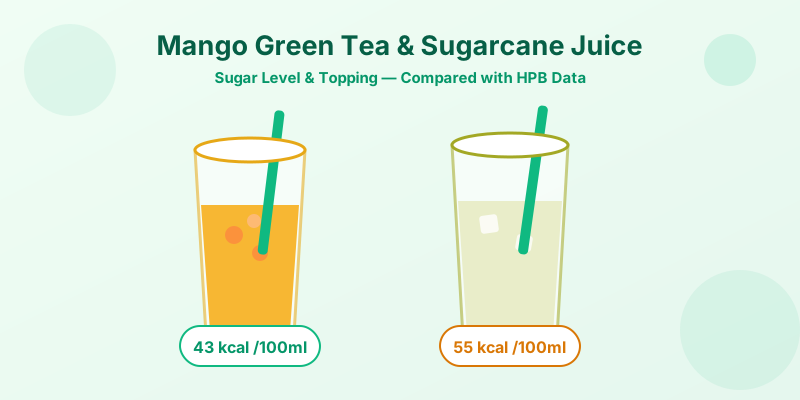
| Regular, with topping | 43 kcal | 8.4g | 10.17g |
| Less sugar, with topping | 43 kcal | 8.64g | 10.29g |
Does "Less Sugar" Actually Save You Anything?
Based on this HPB dataset — not really, at least not for the with-topping version. Regular mango green tea with topping is 43 kcal and 8.4g sugar per 100ml. Less sugar with topping is 43 kcal and 8.64g sugar per 100ml — statistically the same drink. We're not going to pretend there's a meaningful saving there when the data doesn't show one.
What the data does show clearly is that the topping is the real lever, not the sugar-level label. Regular with topping (43 kcal) versus regular without topping (33 kcal) is a genuine 23% calorie difference per 100ml. If you're trying to trim this drink down, skip the pearls or jelly before you bother asking for less sugar.
Real-World Cup Size: What a Full Cup Looks Like
HPB's own default portion for mango green tea is a 500ml medium cup — the same size stalls typically pour. Scaling the per-100ml figures up by that official HPB portion, a regular-with-topping cup works out to 215 kcal and 42g of sugar. This is HPB's own default cup size, not an outside guess — though actual pours will still vary by stall and ice level.
| Variant (per 100ml) | HPB's default 500ml cup |
|---|---|
| No sugar, no topping — 29 kcal, 6.5g sugar | ~145 kcal, ~33g sugar |
| Regular, no topping — 33 kcal, 6.75g sugar | ~165 kcal, ~34g sugar |
| Regular, with topping — 43 kcal, 8.4g sugar | ~215 kcal, ~42g sugar |
Fresh Sugarcane Juice: The Straightforward One
Fresh sugarcane juice is a different case entirely. Per HPB data it's 55 kcal and 13.36g of sugar per 100ml — higher than any mango green tea variant above. But there's an honesty to it: sugarcane juice is pressed straight from the cane, all-natural, with essentially no separate "sugar level" dial to adjust. What you see is what the cane contains; there's no added syrup decision to make at the counter.
HPB's own default portion for fresh sugarcane juice is a 550ml cup, which works out to approximately 303 kcal and 73g of sugar — a meaningful amount for what feels like "just juice," precisely because there's no sugar-free or less-sugar version available to switch to. Smaller 400ml pours would be lower, around 220 kcal, but HPB's own reference size is the larger 550ml cup.
Frequently Asked Questions
Per HPB data, regular mango green tea with topping is 43 kcal per 100ml. Without the topping, the same regular-sugar drink drops to 33 kcal per 100ml — about a 23% reduction. HPB's own default portion is a 500ml cup, so a full cup with topping works out to 215 kcal using HPB's own reference size.
No. HPB's 'no sugar, no topping' entry still shows 6.5g of sugar per 100ml, and the 'no sugar, with topping' version shows 8.2g per 100ml. 'No sugar' at the stall typically means no added sugar syrup was poured in — it doesn't mean the drink is free of sugar, because the mango puree or fruit content itself contains natural fruit sugars that stay in the drink regardless.
Based on the HPB entries we have, not meaningfully for the with-topping version — regular (43 kcal, 8.4g sugar per 100ml) and less sugar (43 kcal, 8.64g sugar per 100ml) are essentially identical per 100ml. The bigger, data-supported lever is dropping the topping altogether, which is a genuine ~23% calorie reduction (43 kcal down to 33 kcal per 100ml).
HPB lists fresh sugarcane juice at 55 kcal per 100ml, with 13.36g of sugar — almost all of it naturally occurring in the cane, since there's typically no separate sugar syrup added at most stalls. HPB's own default portion is a 550ml cup, which works out to approximately 303 kcal and 73g of sugar. A smaller 400ml pour would be lighter, around 220 kcal.
We don't have HPB bubble tea data in this guide, so we're not going to guess at numbers here. For a proper breakdown of bubble tea calories by sugar level, ice level and toppings, see NutriKaki's dedicated bubble tea calories guide.
Nutrition data sourced from the Health Promotion Board (HPB) Singapore food composition database. Calorie values are approximate and vary by brand, preparation and portion size. This article is for general wellness information only and does not constitute medical or dietary advice. Consult a registered dietitian for personalised nutrition guidance. Nutrition data referenced in this article is used under licence from the Health Promotion Board (HPB) of Singapore and may not be redistributed, republished, or reused commercially without NutriKaki's prior written permission.