Mee Rebus, Mee Soto and Soto Ayam Calories in Malaysia, in Grams
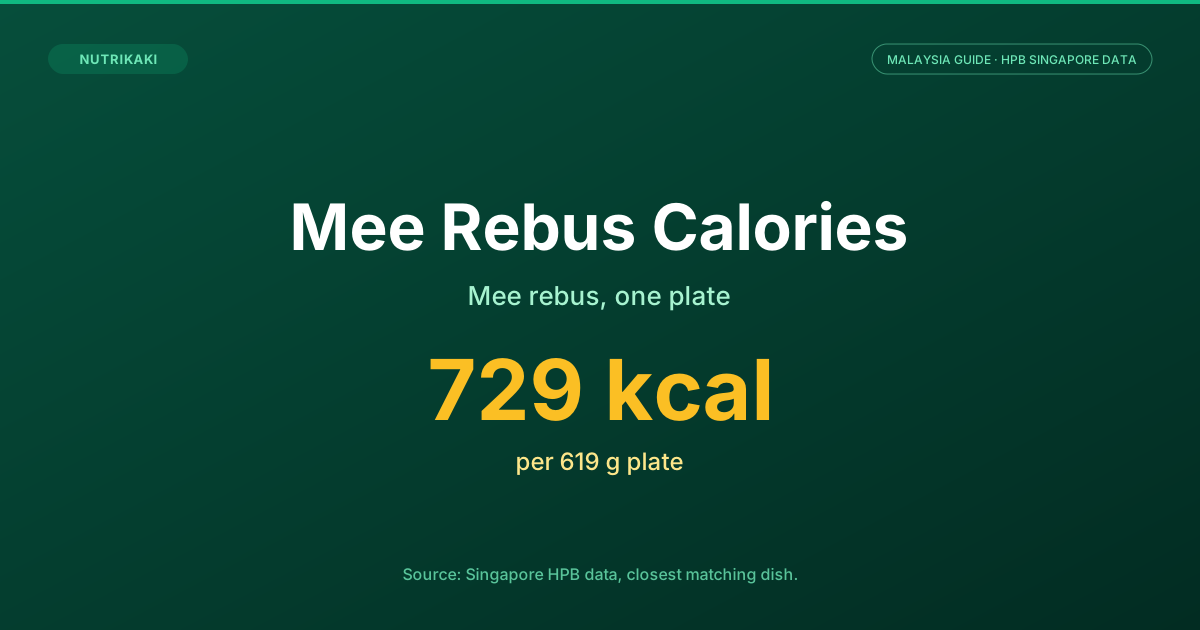
A plate of mee rebus (HPB's 619 g plate) has 729 kcal and 2,466 mg sodium, and a bowl of soto ayam (569 g) has 216 kcal and 2,418 mg sodium, according to HPB Singapore data for the closest dish. Every figure on this page shows the grams it is based on.
Figures checked against the Health Promotion Board (HPB) Singapore food database on 25 October 2026. These are HPB figures for the closest Singapore dish, not measurements taken in Malaysia. Each figure is HPB's per-100 g value x HPB's portion weight x HPB's edible portion.
Mee rebus, mee soto and soto ayam by serving
HPB Singapore lists these six dishes. Each row is HPB's default plate or bowl, with its weight in the Portion column. The kcal per 100 g column is HPB's own per-100 g value. The portions weigh from 330 g to 747.27 g, so use that column to compare dishes by weight. Rows are sorted by kcal per serving, highest first.
| Dish | Portion | kcal | kcal per 100 g | Carbs | Sugar | Sodium |
|---|---|---|---|---|---|---|
| Mee siam | 1 plate, 731 g | 864 kcal | 119 kcal | 124.2 g | 7.6 g | 3,754 mg |
| Mee rebus | 1 plate, 619 g | 729 kcal | 118 kcal | 99.2 g | 2.2 g | 2,466 mg |
| Beehoon soto | 1 bowl, 747.27 g | 665 kcal | 89 kcal | 82.4 g | 5.3 g | 1,928 mg |
| Mee soto | 1 bowl, 622 g | 442 kcal | 71 kcal | 77.8 g | Not shown | 4,068 mg |
| Mee bandung | 1 bowl, 330 g | 327 kcal | 99 kcal | 41.3 g | 7.3 g | 1,412 mg |
| Soto ayam | 1 bowl, 569 g | 216 kcal | 38 kcal | 17.6 g | 6.3 g | 2,418 mg |
Mee soto: we show HPB's figures as published, which are 654 mg sodium per 100 g and 4,068 mg for the 622 g bowl. HPB lists 258 mg per 100 g for its beehoon soto (rice vermicelli in spiced yellow chicken soup), so the two rows differ. We do not show a sugar figure for mee soto.
HPB counts 99.84% of the 619 g mee rebus plate and 99.32% of the 731 g mee siam plate as edible; the figures here apply that.
Of the 6 rows on this page, mee siam has the most kcal per serving, 864 kcal for a 731 g plate, and soto ayam has the fewest, 216 kcal for a 569 g bowl. Per 100 g, mee siam also has the most at 119 kcal per 100 g, and soto ayam the least at 38 kcal per 100 g.
HPB's soto ayam is a soup of shredded chicken, bean sprouts and rice cakes (ketupat). It has no noodles, and a 569 g bowl has 17.6 g carbs.
What HPB's rows contain
- Mee rebus: thick yellow egg noodles in a thick spicy gravy with hard-boiled eggs, tofu, vegetables, shallots, lime and chilli. HPB also lists the gravy on its own: a 340 g bowl of mee rebus gravy has 337 kcal, 44.4 g carbs, 7.3 g sugar and 1,588 mg sodium.
- Mee soto: yellow noodles with shredded chicken in spicy soup.
- Beehoon soto: rice vermicelli in spiced yellow chicken soup.
- Mee bandung: yellow noodles with prawn, chye sim, egg, cucumber, pea, onion, tomato, cabbage and chilli sauce.
- Mee siam: thin rice vermicelli with hard-boiled egg, tofu and lime, in a spicy, tangy asam-based soup.
Not in HPB's data
HPB has no separate entry for mee celup or laksam, so this page gives no figure for them.
How to log it
- Search for the dish name in NutriKaki and pick the matching HPB row.
- Set the grams to match your portion. Every HPB row shows the grams its figures are based on.
- Or take a photo of the plate: the photo log suggests a dish and a portion, and you can change both.
Frequently Asked Questions
HPB lists a 619 g plate of mee rebus at 729 kcal. A 622 g bowl of mee soto has 442 kcal and a 569 g bowl of soto ayam has 216 kcal.
HPB lists a 622 g bowl of mee soto at 4,068 mg sodium, which is 654 mg per 100 g. HPB lists 258 mg per 100 g for beehoon soto, which is 1,928 mg for a 747.27 g bowl. We show HPB's figures as published.
A 619 g plate of mee rebus has 99.2 g carbs. A 622 g bowl of mee soto has 77.8 g and a 569 g bowl of soto ayam has 17.6 g.
HPB describes soto ayam as a soup containing shredded chicken, bean sprouts and rice cakes (ketupat), with no noodles. A 569 g bowl has 216 kcal, 17.6 g carbs, 6.3 g sugar and 2,418 mg sodium.
No. HPB has no separate entry for mee celup or laksam, so this page gives no figure for them.
No. They are HPB Singapore figures for the closest dish, not measurements taken in Malaysia. Stalls in Malaysia vary in size, recipe and portion.
Nutrition data sourced from the Health Promotion Board (HPB) Singapore food composition database, using the closest matching Singapore dish; it is not Malaysian data. Values vary by stall, portion and recipe. This article is for general information only and is not medical or dietary advice. Nutrition data referenced in this article is used under licence from the Health Promotion Board (HPB) of Singapore and may not be redistributed, republished, or reused commercially without NutriKaki's prior written permission.