Karipap (Curry Puff) Calories in Malaysia: 5 Fillings, in Grams
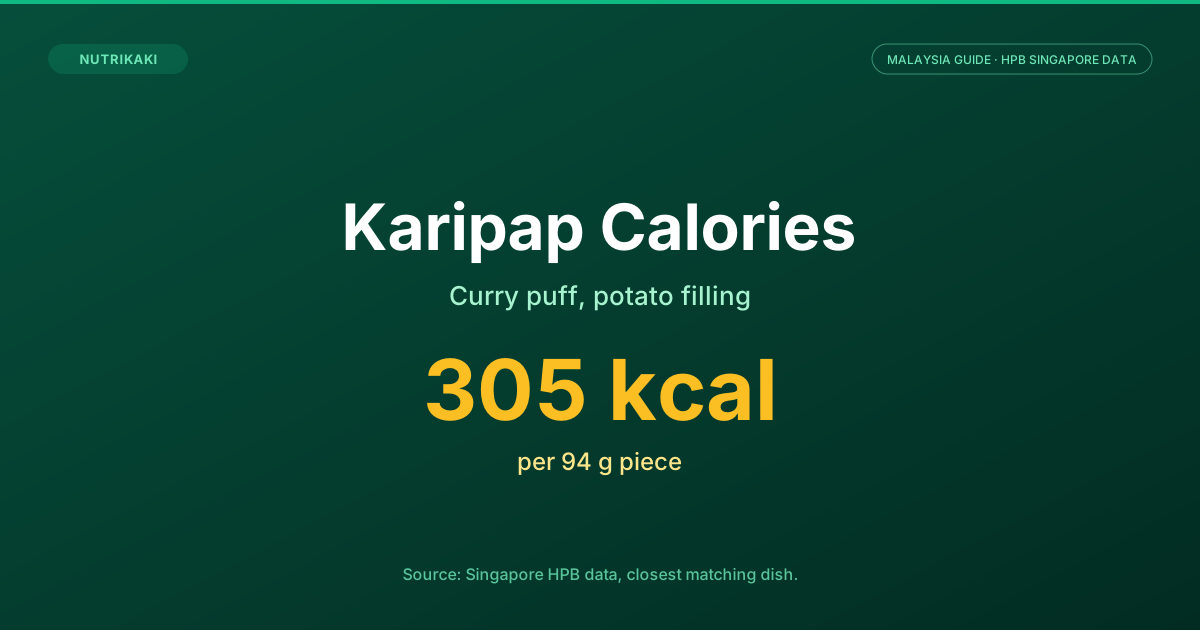
A potato karipap (HPB's curry puff, 94 g piece) has 305 kcal, 32.9 g carbs and 467 mg sodium, according to HPB Singapore data for the closest dish. Every figure on this page shows the grams it is based on.
Figures checked against the Health Promotion Board (HPB) Singapore food database on 25 October 2026. These are HPB figures for the closest Singapore dish, not measurements taken in Malaysia. Each figure is HPB's per-100 g value x HPB's portion weight x HPB's edible portion.
Karipap calories by filling
HPB Singapore lists five curry puff fillings. Each row is HPB's default portion of 1 piece, with its weight in the Portion column. The kcal per 100 g column is HPB's own per-100 g value. The pieces weigh from 78 g to 121 g, so use that column to compare the fillings by weight. Rows are sorted by kcal per piece, highest first.
| Curry puff | Portion | kcal | kcal per 100 g | Carbs | Sugar | Sodium |
|---|---|---|---|---|---|---|
| Curry puff (mutton) | 1 piece, 121 g | 369 kcal | 305 kcal | 42.5 g | HPB lists none | 696 mg |
| Curry puff (potato) | 1 piece, 94 g | 305 kcal | 324 kcal | 32.9 g | 3.4 g | 467 mg |
| Curry puff (chicken) | 1 piece, 81 g | 276 kcal | 341 kcal | 25.8 g | 2.9 g | 387 mg |
| Curry puff (beef) | 1 piece, 78 g | 264 kcal | 339 kcal | 24.3 g | HPB lists none | 452 mg |
| Curry puff (sardine) | 1 piece, 80 g | 252 kcal | 315 kcal | 23.2 g | 3.7 g | 313 mg |
HPB lists no sugar figure for the beef and mutton curry puffs, so those cells read "HPB lists none".
Of the 5 curry puffs on this page, the mutton piece has the most kcal, 369 kcal for a 121 g piece, and the sardine piece has the fewest, 252 kcal for an 80 g piece. Per 100 g the order changes: chicken has the most, 341 kcal per 100 g, and mutton the least, 305 kcal per 100 g.
What HPB's curry puff rows contain
HPB describes every row as a deep-fried pastry filled with potato cubes and egg in a curry paste mixture. The chicken, beef, mutton and sardine rows add that meat or fish to the filling, and the potato row has potato cubes and egg only. HPB lists "karipok", "currypok" and "epok epok" as other names for all five rows, and the chicken row also lists "ayam karipap".
Not in HPB's data
HPB lists these five fillings only. It has no separate row for a mini karipap or for any other filling, so this page gives no figure for them.
How to log it
- Search for the dish name in NutriKaki and pick the matching HPB row.
- Set the grams to match your portion. Every HPB row shows the grams its figures are based on.
- Or take a photo of the plate: the photo log suggests a dish and a portion, and you can change both.
Frequently Asked Questions
A potato karipap (HPB's curry puff, a 94 g piece) has 305 kcal. HPB lists the chicken piece at 276 kcal (81 g), the beef piece at 264 kcal (78 g), the mutton piece at 369 kcal (121 g) and the sardine piece at 252 kcal (80 g).
Of the 5 curry puffs on this page, mutton has the most per piece: 369 kcal for a 121 g piece. Per 100 g, chicken has the most at 341 kcal per 100 g, and mutton the least at 305 kcal per 100 g.
A potato karipap (94 g piece) has 467 mg sodium, a chicken karipap (81 g) has 387 mg, a mutton karipap (121 g) has 696 mg and a sardine karipap (80 g) has 313 mg, per HPB Singapore data. The beef karipap (78 g) has 452 mg.
A potato karipap (94 g piece) has 32.9 g carbs, a chicken karipap (81 g) has 25.8 g, a mutton karipap (121 g) has 42.5 g and a sardine karipap (80 g) has 23.2 g. The beef karipap (78 g) has 24.3 g.
No. They are HPB Singapore figures for the closest dish, not measurements taken in Malaysia. Stalls in Malaysia vary in size, recipe and portion.
Nutrition data sourced from the Health Promotion Board (HPB) Singapore food composition database, using the closest matching Singapore dish; it is not Malaysian data. Values vary by stall, portion and recipe. This article is for general information only and is not medical or dietary advice. Nutrition data referenced in this article is used under licence from the Health Promotion Board (HPB) of Singapore and may not be redistributed, republished, or reused commercially without NutriKaki's prior written permission.