Rendang and Ayam Masak Merah Calories in Malaysia: 7 Lauk, in Grams
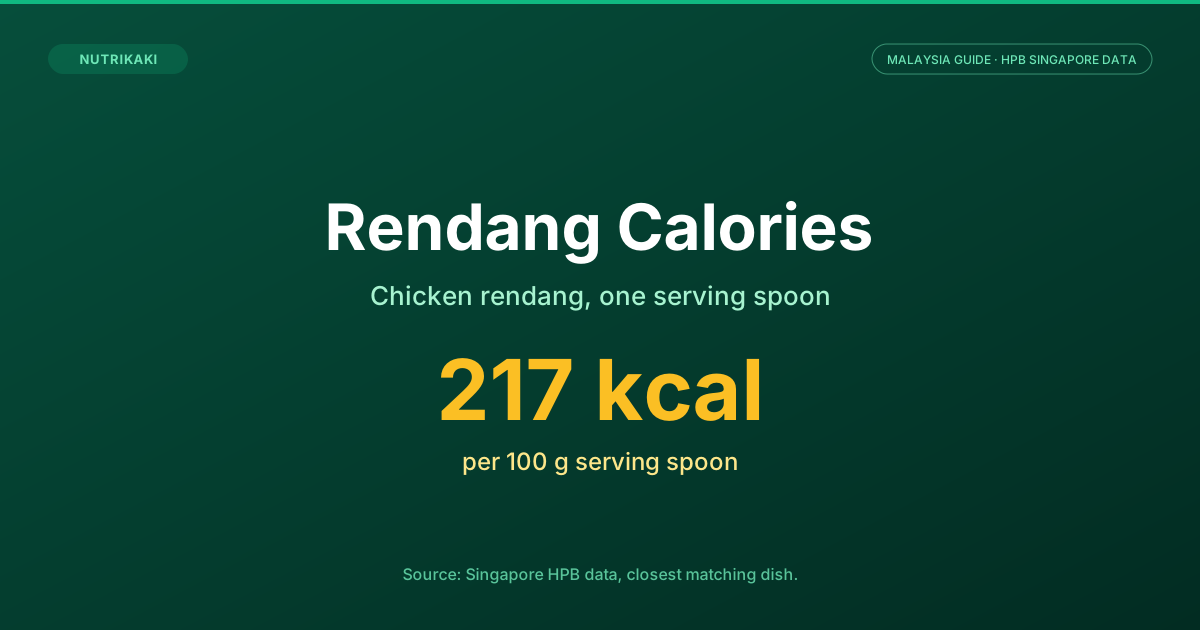
A serving spoon (100 g) of chicken rendang has 217 kcal and 639 mg sodium, and a serving spoon (100 g) of ayam masak merah has 80 kcal and 124 mg sodium, according to HPB Singapore data for the closest dish. For ayam masak merah HPB counts 65% of the spoon as edible, so the figures use 65 g of food.
Figures checked against the Health Promotion Board (HPB) Singapore food database on 25 October 2026. These are HPB figures for the closest Singapore dish, not measurements taken in Malaysia. Each figure is HPB's per-100 g value x HPB's portion weight x HPB's edible portion.
Rendang and masak merah by serving spoon
HPB Singapore lists rendang and masak merah by the serving spoon. Each row is HPB's default portion of 1 serving spoon, with its weight in the Portion column. The Edible column is the share of that weight HPB counts as food. The kcal per 100 g column is HPB's own per-100 g value, before the edible share is applied. Rows are sorted by kcal per spoon, highest first.
| Lauk | Portion | Edible | kcal | kcal per 100 g | Carbs | Sugar | Sodium |
|---|---|---|---|---|---|---|---|
| Beef rendang | 1 serving spoon, 100 g | 100% | 223 kcal | 223 kcal | 1.4 g | 0.8 g | 501 mg |
| Chicken rendang | 1 serving spoon, 100 g | 100% | 217 kcal | 217 kcal | 4.2 g | HPB lists none | 639 mg |
| Daging masak merah | 1 serving spoon, 100 g | 100% | 199 kcal | 199 kcal | 11.2 g | 11.0 g | 452 mg |
| Mutton rendang | 1 serving spoon, 100 g | 100% | 182 kcal | 182 kcal | 4.2 g | HPB lists none | 642 mg |
| Sambal chicken | 1 serving spoon, 100 g | 69% | 142 kcal | 206 kcal | 1.0 g | 0.1 g | 191 mg |
| Ikan masak pedas | 1 serving spoon, 100 g | 75% | 82 kcal | 109 kcal | 2.0 g | HPB lists none | 483 mg |
| Ayam masak merah | 1 serving spoon, 100 g | 65% | 80 kcal | 123 kcal | 2.1 g | 1.8 g | 124 mg |
HPB counts 65% of the ayam masak merah spoon, 75% of the ikan masak pedas spoon and 69% of the sambal chicken spoon as edible, so those figures count 65 g, 75 g and 69 g of food. That is why ayam masak merah shows 123 kcal per 100 g next to 80 kcal for the spoon.
HPB lists no sugar figure for chicken rendang, mutton rendang or ikan masak pedas, so those cells read "HPB lists none".
Of the 7 rows on this page, beef rendang has the most kcal per spoon, 223 kcal for a 100 g spoon, and ayam masak merah has the fewest, 80 kcal for a 100 g spoon (with 65 g counted as edible). Per 100 g of food, ikan masak pedas has the fewest, 109 kcal per 100 g. Mutton rendang has the most sodium, 642 mg for a 100 g spoon, and ayam masak merah the least, 124 mg. Of the 4 rows that list a sugar figure, daging masak merah has the most, 11.0 g for a 100 g spoon.
What HPB's rows contain
- Ayam masak merah: Malay-style cooked chicken in spicy red tomato gravy.
- Daging masak merah: tender beef simmered in red tomato sauce.
- Chicken rendang: chicken simmered with spices and coconut milk.
- Beef rendang: a Malay-style spicy, rich and creamy beef stew made by simmering beef with coconut milk and spices.
- Mutton rendang: lean mutton in a coconut and chilli gravy.
- Ikan masak pedas: fish in spicy tamarind curry.
- Sambal chicken: stir-fried chicken in belachan (fermented shrimp paste) and chilli.
Not in HPB's data
HPB lists rendang for chicken, beef and mutton only, and masak merah for chicken (ayam) and beef (daging) only. It has no other rendang or masak merah rows, so this page gives no figure for them.
How to log it
- Search for the dish name in NutriKaki and pick the matching HPB row.
- Set the grams to match your portion. Every HPB row shows the grams its figures are based on.
- Or take a photo of the plate: the photo log suggests a dish and a portion, and you can change both.
Frequently Asked Questions
HPB lists 1 serving spoon (100 g) of ayam masak merah at 80 kcal, with 2.1 g carbs, 1.8 g sugar and 124 mg sodium. HPB counts 65% of the spoon as edible, so the figures use 65 g of food.
HPB lists 1 serving spoon (100 g) of chicken rendang at 217 kcal, beef rendang at 223 kcal and mutton rendang at 182 kcal. Each spoon is 100 g.
In HPB's data, a serving spoon (100 g) of mutton rendang has 642 mg sodium, chicken rendang has 639 mg and beef rendang has 501 mg. Daging masak merah has 452 mg for 100 g.
A serving spoon (100 g) of chicken rendang has 4.2 g carbs, mutton rendang has 4.2 g and beef rendang has 1.4 g.
HPB counts only 65% of the 100 g ayam masak merah spoon as edible, so its 80 kcal is for 65 g of food. HPB's value for the dish itself is 123 kcal per 100 g.
No. They are HPB Singapore figures for the closest dish, not measurements taken in Malaysia. Stalls in Malaysia vary in size, recipe and portion.
Nutrition data sourced from the Health Promotion Board (HPB) Singapore food composition database, using the closest matching Singapore dish; it is not Malaysian data. Values vary by stall, portion and recipe. This article is for general information only and is not medical or dietary advice. Nutrition data referenced in this article is used under licence from the Health Promotion Board (HPB) of Singapore and may not be redistributed, republished, or reused commercially without NutriKaki's prior written permission.