Milo Calories & Sugar: Every Format Compared
Ask someone how many calories are in "a Milo" and they'll usually answer as if Milo is one drink. It isn't. There's iced Milo, Milo siu dai, Milo gao, Milo Dinosaur, Milo Godzilla, the 3-in-1 sachet you make at home, and the ready-to-drink packet from the fridge — and the calorie and sugar range across all of them is genuinely wide.
Part of that range comes from the format itself (a sachet you mix at home is not the same thing as a kopitiam-style iced Milo). Part of it comes from how you order — "siu dai," "gao," and toppings like an extra scoop of powder all change the numbers. This guide walks through every Milo variant in HPB Singapore's food database, so you can see exactly where the calories and sugar are coming from.
One important note before we start: all the figures below are per 100ml (for prepared drinks) or per 100g (for dry powder), straight from HPB's database. They are not per-glass numbers. We'll translate them into rough real-world glass sizes further down — clearly marked as our own estimate, not official HPB data.
Milo Calories at a Glance (per 100ml / 100g)
The Full Calorie & Sugar Breakdown
Here's every Milo format in HPB's database, from lowest to highest calorie per 100g/100ml. Sachets and dry powder are weighed dry, before you add water or milk, so don't compare them directly against the prepared drinks — see the note below the table.
| Milo Format | Calories | Sugar | Fat (sat) | Notes |
|---|---|---|---|---|
| Milo 3-in-1 sachet | 48 kcal | 6.07g | 1.01g (0.52g) | Dry powder, per 100g |
| Milo 2-in-1 sachet | 52 kcal | 5.43g | 1.21g (0.6g) | Dry powder, per 100g |
| Milo (powder, dry) | 59 kcal | 5.47g | 1.3g (0.71g) | Plain dry powder, per 100g |
| Milo Gao Siew Dai (powder) | 59 kcal | 5.36g | 1.5g (0.68g) | Concentrated + less sugar, per 100g |
| Milo (packaged, ready-to-drink) | 60 kcal | 6.95g | 1.7g (0.95g) | Prepared drink, per 100ml |
| Iced Milo siu dai | 62 kcal | 7.14g | 1.64g (0.9g) | Prepared drink, per 100ml |
| Milo Peng (packaged, iced w/ milk) | 63 kcal | 5.02g | 1.68g (0.8g) | Prepared drink, per 100ml |
| Milo Godzilla (double Milo + toppings) | 76 kcal | 5.75g | 2.4g (1.29g) | Prepared drink, per 100ml |
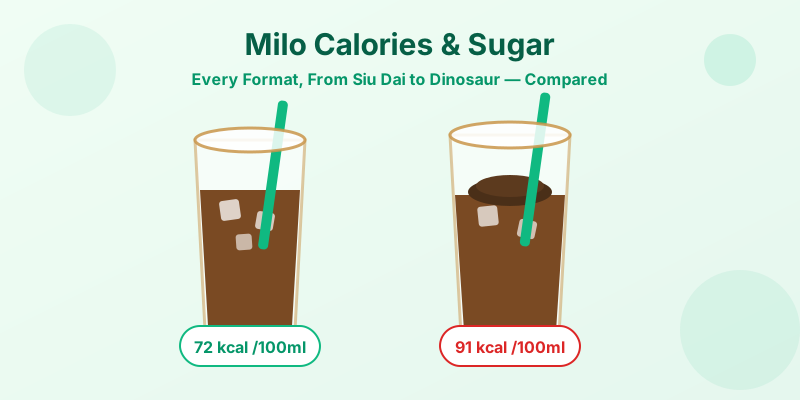
| Iced Milo (regular) | 72 kcal | 8.66g | 1.89g (0.98g) | Prepared drink, per 100ml |
| Milo siu dai (less sugar, another entry) | 80 kcal | 9.2g | 2.12g (1.16g) | Prepared drink, per 100ml |
| Milo Dinosaur | 91 kcal | 11.28g | 2.69g (1.24g) | Iced Milo + extra powder on top, per 100ml |
| Milo (as a mixed drink) | 93 kcal | 11.16g | 2.44g (1.27g) | Prepared drink, per 100ml |
Per-100ml Isn't Per-Glass — Here's the Real-World Translation
Every figure above is per 100ml or 100g, exactly as HPB records it. A kopitiam iced Milo glass, though, is typically poured at around 250-300ml — roughly 2.5 to 3 times the HPB serving size. So a regular iced Milo at 72 kcal per 100ml works out to roughly 180-215 kcal for a full glass, and its 8.66g of sugar per 100ml becomes roughly 22-26g of sugar in a real glass.
To be clear: this glass-size translation is our own rough approximation for everyday context, not an HPB-published per-serving figure — actual kopitiam pours vary by stall, ice quantity and cup size. Use it as a ballpark, not an exact count.
| Format (per 100ml) | Rough real glass (250-300ml) — our estimate |
|---|---|
| Iced Milo siu dai — 62 kcal, 7.14g sugar | ~155-186 kcal, ~18-21g sugar |
| Iced Milo (regular) — 72 kcal, 8.66g sugar | ~180-216 kcal, ~22-26g sugar |
| Milo Dinosaur — 91 kcal, 11.28g sugar | ~228-273 kcal, ~28-34g sugar |
| Milo (mixed drink) — 93 kcal, 11.16g sugar | ~233-279 kcal, ~28-33g sugar |
Siu Dai vs Gao: What Are You Actually Changing?
"Siu dai" and "gao" control two different things, and mixing them up is where a lot of the confusion comes from.
Sachets and Powder: A Different Category
The 2-in-1 sachet (52 kcal, 5.43g sugar per 100g), 3-in-1 sachet (48 kcal, 6.07g sugar per 100g) and plain dry Milo powder (59 kcal, 5.47g sugar per 100g) are all measured as dry powder — before you add hot water, cold milk or ice. That means you can't line them up directly against the prepared drinks above; how much powder you actually spoon in, and what you mix it with, changes the final glass more than the packet's own numbers do.
What the sachet numbers are useful for is portion control. A single sachet is a fixed, pre-measured amount of powder — you can't accidentally make it "extra gao" the way you might over-scoop from a tin. If you're trying to keep Milo consistent day to day, sachets take some of the guesswork out.
Which Milo Should You Actually Order?
Frequently Asked Questions
HPB's database lists iced Milo at 72 kcal per 100ml. A typical kopitiam glass is roughly 250-300ml, so a real glass works out to roughly 180-220 kcal as a rough real-world estimate — this is our own approximate translation, not an official per-glass HPB figure. Milo Dinosaur and Milo Godzilla, which add extra Milo powder on top, will run higher again.
Per HPB data, iced Milo siu dai is 62 kcal per 100ml versus 72 kcal for regular iced Milo — about 14% less. Sugar drops from 8.66g to 7.14g per 100ml. It's a real but modest saving, not a dramatic one, since most of Milo's calories come from the milk and malt powder itself, not just the added sugar.
Yes, meaningfully. Milo Dinosaur (iced Milo topped with extra dry Milo powder) is 91 kcal per 100ml versus 72 kcal for regular iced Milo — about 26% more, and the sugar is higher too. The scoop of powder on top isn't dissolved into the drink's volume, so you're getting a genuine calorie and sugar top-up, not just texture.
Per 100g of dry powder, Milo 3-in-1 sachet (48 kcal) and 2-in-1 sachet (52 kcal) look lower than iced Milo (72 kcal per 100ml prepared drink), but these numbers aren't directly comparable — one is dry powder weight, the other is a prepared liquid. What matters more practically is that sachets are pre-portioned, so it's harder to accidentally order a "stronger" version than intended.
They control different things. Gao means a stronger, more concentrated Milo mix. Siu dai means less sugar. You can order them together — "Milo gao siu dai" — for a strong-tasting Milo with less added sugar. HPB's Milo Gao Siew Dai entry (concentrated plus less sugar) comes in at 59 kcal per 100g, with sugar at 5.36g, among the lower-sugar options in this guide.
Nutrition data sourced from the Health Promotion Board (HPB) Singapore food composition database. Calorie values are approximate and vary by brand, preparation and portion size. This article is for general wellness information only and does not constitute medical or dietary advice. Consult a registered dietitian for personalised nutrition guidance. Nutrition data referenced in this article is used under licence from the Health Promotion Board (HPB) of Singapore and may not be redistributed, republished, or reused commercially without NutriKaki's prior written permission.